
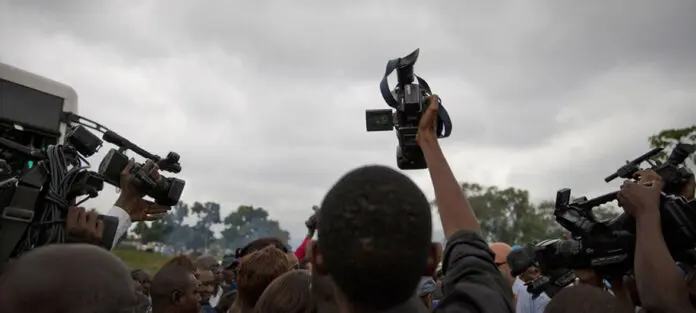
In 2024 and 2025, 189 journalists lost their lives in violent attacks, compared with 162 in 2022 and 2023. This represents a 20 per cent increase, the highest in a decade. The majority (67 per cent) of the killings took place in countries at war. In nearly nine out of ten cases, those responsible are not brought to justice.
These are the main findings of the UNESCO Director-General’s Report on the Safety of Journalists and the Danger of Impunity, released on the occasion of the International Day to End Impunity for Crimes against Journalists, observed on 2 November.
“Across the world, journalists continue to pay an exorbitant price for telling the truth,” said United Nations Secretary-General António Guterres in his message for the Day.
“Media professionals play an essential role in keeping the public informed and holding power to account. Yet they are often harassed, surveilled, prosecuted, physically assaulted or imprisoned, and even tortured or killed, simply for doing their jobs.”
“This scandal must end,” he insisted.
This year’s theme captures the situation succinctly: “Threats evolve. Impunity persists.” New technologies and weapons are changing the ways journalists are targeted, but one thing remains constant: those who kill them are rarely held accountable.
War zones: the most dangerous places for journalists
In 2024 and 2025, 67 per cent of killings of journalists took place on the front lines, compared with 43 per cent in the previous report covering 2022 and 2023.
The State of Palestine tops this list by a wide margin, with at least 62 journalists killed in two years, including 32 in 2025. Mexico, Yemen, Sudan and Ukraine are also among the deadliest territories.
The use of drones is taking on a new role. A total of 50 journalists have been killed in drone strikes in just six conflicts, accounting for around 40 per cent of deaths in war zones.
“In conflict situations, the impunity rate approaches 100 per cent,” Guterres warned.
Khaled El-Enany, Director-General of UNESCO, called for compliance with Security Council Resolution 2222, adopted unanimously in 2015, which reaffirms the protection of journalists as civilians in armed conflicts.
Impunity is on the rise again
The global rate of impunity for the murders of journalists has risen by one percentage point, reaching 86 per cent. It had, however, been falling steadily, from 95 per cent in 2012 to 85 per cent in 2024. This is the first time the rate has risen again since UNESCO began tracking this indicator in 2012.
Of the cases recorded since 2006, fewer than 14 per cent have been resolved through the courts. In other words, only 223 cases have been resolved out of the 1,641 murders recorded by UNESCO over the past twenty years. According to the 2024 report, cases resolved between 2006 and 2023 took an average of four years to reach a judicial decision.
Impunity leads to further killings, and its consequences extend far beyond the victims and their families. When attacks go unpunished, public-interest journalism can be silenced, particularly investigations into corruption, human rights violations and criminal activities.
Far more than murders
Murder is the most extreme form of censorship, but it is not the only one. Journalists also face kidnapping, torture, arbitrary detention, intimidation and judicial harassment through strategic lawsuits against public participation, commonly known as SLAPPs (Strategic Lawsuit Against Public Participation).
Women journalists are particularly affected by these threats, in addition to gender-based violence and online harassment.
In 2024 and 2025, 14 women journalists were killed, all but one in conflict zones.
According to a 2021 study by UNESCO and the International Center for Journalists, 73 per cent of women journalists surveyed had experienced online violence, while one in four had received threats of physical violence, including death threats.
Signs of progress
According to UNESCO, accountability has also advanced. In countries not affected by armed conflict, 62 journalist killings were recorded, the lowest number in the past 18 years. Since the launch of the UN Plan of Action on the Safety of Journalists and the Issue of Impunity in 2012, the impunity rate in those countries has fallen from 94 per cent to 77 per cent.
“But we must do more,” Guterres acknowledged.
The Plan, the first coordinated UN effort in this area, brings together UN agencies, national authorities, media organisations and civil society, and has contributed to the establishment of national protection mechanisms in at least 50 countries.
UNESCO is calling for accountability mechanisms to keep pace with emerging threats, particularly in conflict settings. The Secretary-General urged that all cases be investigated, all perpetrators prosecuted, and online attacks brought to an end.
“On this International Day to End Impunity for Crimes against Journalists, we demand justice,” Guterres concluded. “When journalists are targeted and their work is erased, we all become victims.”
Background
The United Nations General Assembly proclaimed 2 November as the International Day to End Impunity for Crimes against Journalists through resolution A/RES/68/163, adopted in 2013. The date commemorates the murder of two French journalists in Mali on 2 November 2013. The resolution condemns all attacks against journalists and media workers and calls on States to prevent violence, bring perpetrators to justice, ensure that victims have access to remedies, and promote a safe environment in which journalists can work independently.