
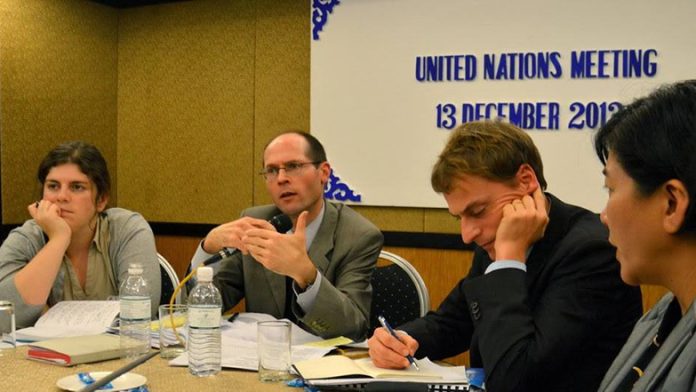
The United Nations Special Rapporteur on Extreme Poverty and Human Rights, Olivier De Schutter, began his three-year mandate in May 2020 in the midst of the Covid-19 crisis.

UNRIC interviewed Olivier De Schutter on his priorities, the COVID-19 pandemic, his hopes for the future and his motivation.
What are your priorities as the new UN Special Rapporteur on Extreme Poverty and Human Rights?
 The economic and social crisis caused by COVID-19 has highlighted the deficits of our social protection systems. It must be said loud and clear, we are wide of the mark. 55% of the world’s population have no social protection, and only 29%, concentrated in rich countries, is covered at all stages of life.
My priority is, therefore, to encourage all countries to set up social protection floors, to which they committed in 2012 by adopting Recommendation No. 202 of the International Labour Organization (ILO).
Moreover, target 1.2 of the Sustainable Development Goals is yet another instrument to eradicate poverty. It stipulates that the proportion of people living in poverty should be more than halved by 2030.
During this health crisis, a large number of countries urgently adopted cash transfer systems to help the most vulnerable groups, or they relaxed access conditions to existing systems. These systems must be made sustainable and a policy of permanent social protection should be encouraged. I will also advocate to strengthen international solidarity for the right to social security.
How can you put these priorities into practice?
My role is to alert governments on which issues to avoid, but also to identify emerging practices and solutions, including those stemming from the inventiveness of people living in poverty or from the organisations representing them.
In order to do so, we submit reports to the UN General Assembly and the Human Rights Council, but we also send allegation letters to governments, asking them to explain certain information we received. We also conduct missions in countries that invite us.
What is the impact of the pandemic on the poorest communities?
The pandemic crisis will lead to a major economic recession, of the order of 4% worldwide. In this crisis, developing countries are the most fragile. The weight of their external debt is important and deprives them of the possibility of adopting ambitious economic recovery plans.

In addition, 61% of the world’s workforce, or 2 billion people, are working in precarious job situations in the informal economy, without social protection. The proportion is even higher in poor countries. The impact on the poverty rate will, therefore, be dramatic. Almost 180 million more people will see their incomes drop below US $ 3.20 per day.

What are the solutions?
We must build a development model that places social inclusion and ecological sustainability at the heart of public policies. It has long been considered that economic growth was the key to solve all our ills. However, this reasoning dates from the last century and is now showing its limits.
Promotion of equality must be our priority, because societies with the lowest income disparities are better equipped to face the challenges they are presented with, and because solidarity is a condition for ecological transition.
The Sustainable Development Goals invite us to build such a development model.
What is your source of motivation in this fight against extreme poverty?
As the son of a diplomat, I was fortunate to travel extensively to developing countries until my late teens. I was especially touched by my years spent in India and Rwanda, but above all, during my mandate as Special Rapporteur on the Right to Food between 2008 and 2014. I understood that scientifically flawless reports are not enough to make governments and other stakeholders act. It is necessary to convey to decision-makers both the findings of scientists and the concerns of people living in poverty so that they can better understand expectations and make better use of the instruments at their disposal. I will devote myself completely to this task.
Additional links: