
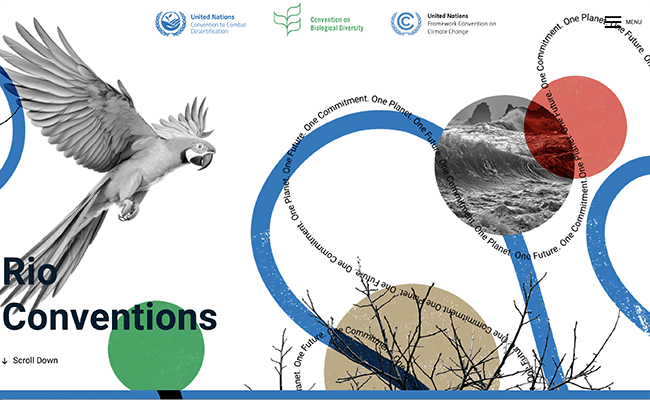
The leaders of the three Rio Conventions recently met in Bonn to chart the next stage of their collaboration. Yasmine Fouad, the new UNCCD Executive Secretary, chaired the meeting of the Joint Liaison Group, welcoming her counterparts Simon Stiell of the UN Framework Convention on Climate Change (UNFCCC) and Astrid Schomaker of the UN Convention on Biological Diversity (CBD).
Together, they discussed priority actions for 2025–2026 and pledged to strengthen cooperation to address the triple planetary crisis of climate change, biodiversity loss and land degradation. One immediate outcome of the meeting is the launch of the Rio Synergies platform, unveiled to showcase how the three conventions are stepping up joint action. The new website highlights the benefits of integrated approaches and provides a window into how countries, communities and institutions can work across climate, biodiversity and land agendas.
Some 30 years ago, at the Rio Earth Summit, the world agreed on three landmark treaties to protect the planet: the UNCCD, the CBD and the UNFCCC. Each tackles a different piece of the environmental puzzle—but all share one truth: climate change, biodiversity loss and land degradation are deeply connected, and solving one equals tackling them together.
The rationale for closer cooperation is clear: Humanity is on track to reach ten billion people by 2050, just as nature’s life-support systems are reaching breaking point. Almost one million species are at risk of extinction. Three-quarters of the planet’s land has been transformed by human activity. And if greenhouse gas emissions continue unchecked, the world is set to overshoot the 1.5°C warming limit within decades.
At the heart of cooperation is a shared conviction: when climate, land and biodiversity goals are pursued together, the results are stronger, more cost-effective and longer lasting. By linking their mandates, the Rio conventions are committed to turning overlapping challenges into shared opportunities—delivering solutions that benefit people, economies and ecosystems alike.
The new platform demonstrates how this can work in practice. It showcases key areas for action, such as sustainable land use planning, nature-positive food production, renewable energy transition and gender-responsive action. It also highlights country case studies where integrated projects are already making a difference: Rwanda’s nationwide restoration strategy combining reforestation, agroforestry and land recovery; Central Asia’s efforts to restore vast degraded steppes as carbon sinks; and Panama’s “Nature Pledge,” which unites its climate, biodiversity and land commitments under a single national framework, among others.
The Rio synergies approach is centered around three pillars. First is country support: helping governments strengthen policies, develop integrated plans and build negotiation skills through joint capacity-building. Second is coherence and complementarity: aligning work on shared themes like food systems, forests and water, and engaging Indigenous Peoples and youth. Third is outreach and visibility: speaking with one voice at global events, promoting a joint narrative and sharing inspiring examples of synergy in action.
As the three Executive Secretaries agreed, climate change, biodiversity loss and land degradation are not separate challenges—they are different symptoms of one planetary crisis. By strengthening synergies, the Rio Conventions aim to help humanity heal its relationship with nature and build a more resilient, sustainable future for all. The Rio journey now leads to 2026 — the triple COP year when all three conventions will hold their governing conferences— a pivotal convergence to align national commitments, showcase joint solutions and generate the political momentum needed to translate promises into action on the ground.
Join the Rio journey at https://rioconventions.org