
New UN websites & publications
TOPIC OF THE MONTH: Glaciers

English: https://www.un-glaciers.org/en
French: https://www.un-glaciers.org/fr
Spanish: https://www.un-glaciers.org/es
In December 2022, the UN General Assembly adopted resolution 77/158 to declare 2025 as the International Year of Glaciers’ Preservation, accompanied by the proclamation of March 21st of each year as the World Day for Glaciers starting in 2025.
UNESCO and the World Meteorological Organization (WMO) officially launched this International Year on 21 January 2025, marking a crucial milestone in global efforts to protect these essential water towers that provide freshwater to over 2 billion people worldwide.
Introduction for Policymakers on the International Year of Glaciers’ Preservation (2-pager)
https://www.un-glaciers.org/en/articles/introduction-policymakers-international-year-glaciers-preservation
“Glaciers are a crucial part of many mountain ecosystems. Billions of people depend on mountain water resources that often include essential contributions from glaciers. We can still preserve some of these glaciers, but only if we act now.”

English: https://courier.unesco.org/en/articles/vanishing-glaciers
French: https://courier.unesco.org/fr/articles/glaciers-chronique-dune-fonte-annoncee
Spanish: https://courier.unesco.org/es/articles/glaciares-en-peligro-de-extincion
This issue contains the following articles:
• Glaciers, the fragile mirrors of climate change
• “Kilimanjaro is compelling from both aesthetic and scientific perspectives”: An interview with Douglas Hardy
• Glaciers under close surveillance
• Technology to combat glacier melting in China
• Central Asia, a region of high priority
• Melting ice reveals the past
• Traditions shaken by global warming
• Iceland: See Vatnajökull and die?
• “I draw to portray the sublime beauty and vulnerability of polar ice”: An interview with Zaria Forman

The June 1969 issue of UNESCO Courier included on article titled “Glaciers on the move” that might make interesting reading from the historical perspective (discovered thanks to the UNESCO Digital Library)
English: https://unesdoc.unesco.org/ark:/48223/pf0000078244_en
French: https://unesdoc.unesco.org/ark:/48223/pf0000078244_fre
Spanish: https://unesdoc.unesco.org/ark:/48223/pf0000078244_spa

https://unesdoc.unesco.org/ark:/48223/pf0000383551
This report provides the first global assessment of both the current state and future scenario of glaciers in World Heritage sites. World Heritage glaciers cover almost 10% of the Earth’s glacierized area and play a crucial role in sustaining life on Earth. However, they are retreating at an accelerated rate because of climate change. By combining satellite data and projections at the site level, this study quantifies the extent of World Heritage glaciers’ retreat and its impact on global sea-level rise and provides projections of glacier mass loss. It also provides key information to facilitate dialogue between policymakers and local stakeholders in the development of effective actions to counteract substantial glacier retreat and to respond to subsequent inevitable changes in glacierized sites.
UN in General
Summit of the Future Outcome Documents
now available in all official languages:
https://digitallibrary.un.org/record/4063333

https://www.un.org/esa/foresight/
This new report from UN DESA shows how its work provides policymakers with strategic foresight analysis and other tools to help them understand emerging trends, as well as leverage new opportunities for sustainable development. It illustrates what UN DESA does to help countries in their forward-planning to address new technologies, build national capacities to achieve a just energy transition, and build statistical capacities, for example.

To mark the 80th anniversary of the liberation of the Auschwitz-Birkenau camp, UNESCO has published three new guides to help educators and journalists better combat Holocaust denial, the distortion and manipulation of historical facts relating to the Holocaust, and contemporary forms of anti-Semitism.
The Guide for teachers and the Lesson activities for secondary education delve into the specifics of how Holocaust denial and anti-Semitic discourse appear online and in the classroom, while also offering survivor testimonies and lessons plans to help teachers develop their pupils’ knowledge and critical thinking skills in the face of disinformation about the Holocaust.
The Guide for journalists presents the existing legal frameworks relating to Holocaust dis-information, and provides recommendations for media professionals to help them cover cases of Holocaust denial and anti-Semitism.
These new tools complement UNESCO’s numerous and authoritative publications, including “AI and the Holocaust: Rewriting History? The Impact of Artificial Intelligence on Understanding the Holocaust” (2024), “History Under Attack: Holocaust denial and distortion on social media” (2022), and “Addressing anti-semitism through education: guidelines for policymakers” (2018).
Economic Growth and Sustainable Development

https://unu.edu/ias/news/new-podcast-explores-impact-and-potential-artificial-intelligence
This new podcast explores the intersection of artificial intelligence (AI), higher education and sustainability. Featuring insights from leading experts and practitioners, the podcast aims to advance the global conversation on the ethics, opportunities and disruptions that AI brings to education, and its role in achieving the SDGs.
Climate Services Dashboard (WMO)
https://tinyurl.com/yc8y4xje
The World Meteorological Organization (WMO) has launched the Climate Services Dashboard, an innovative tool designed to track climate service capacities globally. It enhances data-driven planning and resource allocation, ensuring climate services play a complementary role in national climate action plans. This interactive platform supports decision-makers, National Meteorological and Hydrological Services (NMHSs), and development partners by providing insights into climate policy, climate services capacities, and investment trends, helping them align resources and strategies accordingly. It helps identify gaps and opportunities in key sectors like agriculture, health, energy, and disaster risk reduction. It is an indispensable tool to support sustainable development.

https://unece.org/statistics/publications/data-climate-action-how-national-statistical-offices-can-contribute
This new UNECE publication provides guidance how official statistics can contribute to the reporting under the Paris Agreement; how to provide data for climate change mitigation, adaptation, just transition and to measure climate-related costs, transfers, and financial flows; and how to effectively communicate the available information to the public. For each of these topics, it describes the policy context, highlights what NSOs can offer now, identifies gaps they could fill in the future, and provides recommendations on how to better meet the information needs of policymakers and the public.

https://hdl.handle.net/10986/42386
This work aims to offer a strategic approach to policymakers when undertaking digital transformation reforms in education and skills development systems, with a focus on “how.” It builds on the World Bank education vision framework offered in realizing the future of Learning by unpacking the digital cross-cutting area of “Invest wisely in technology”, looking into how this may be done to maximize impact at scale for all.
https://hdl.handle.net/10986/42715
This report explores the opportunities and challenges for developing economies arising from digital trade and discusses the role of international cooperation in tackling these opportunities and challenges. The report considers policy actions in the areas of digital infrastructure, skills, international support for capacity development, and the regulatory and policy environment. Specific policy issues include the WTO e-commerce moratorium, regulation of cross-border data flows, competition policies, and consumer protection.
Finance, Integrity and Governance initiative (UNDP)
https://www.undp.org/publications/finance-integrity-and-governance-initiative

The FIG Initiative consists of three multi-stakeholder symposia that provide stakeholders with a space to examine emerging issues on financial integrity and governance in an informal, Chatham House Rule-based, safe space. Each symposium is followed by a working paper that summarizes key insights and recommendations surfaced during the discussions.
The FIG Working Papers are available to download on this page. The first paper is based on a FIG Symposium in May 2024, and focuses on financial integrity in connection with the two topics of international tax cooperation and illicit financial flows (IFFs). The second paper, based on a FIG symposium in October 2024, covers financial integrity in relation to the two themes of sovereign debt and professional service providers’ role regarding IFFs and tax abuse. The third symposium will take place in March 2025 and a working paper will follow.
The Food Systems Countdown Report 2024: Tracking progress and managing interactions (Columbia University / Cornell University / FAO / GAIN)
https://openknowledge.fao.org/handle/20.500.14283/cd3829en


https://hdl.handle.net/10986/42452
Global growth is expected to hold steady at 2.7 percent in 2025-26. However, the global economy appears to be settling at a low growth rate that will be insufficient to foster sustained economic development—with the possibility of further headwinds from heightened policy uncertainty and adverse trade policy shifts, geopolitical tensions, persistent inflation, and climate-related natural disasters. Against this backdrop, emerging market and developing economies are set to enter the second quarter of the twenty-first century with per capita incomes on a trajectory that implies substantially slower catch-up toward advanced-economy living standards than they previously experienced. Without course corrections, most low-income countries are unlikely to graduate to middle-income status by the middle of the century. Policy action at both global and national levels is needed to foster a more favorable external environment, enhance macroeconomic stability, reduce structural constraints, address the effects of climate change, and thus accelerate long-term growth and development.
see also: Global Economy Stabilizes, But Developing Economies Face Tougher Slog (Press Release, 16 January 2025): https://www.worldbank.org/en/news/press-release/2025/01/16/gep-january-2025-press-release
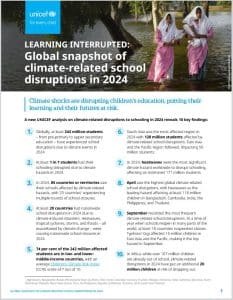
https://www.unicef.org/reports/learning-interrupted-global-snapshot-2024
At least 242 million students in 85 countries had their schooling disrupted by extreme climate events in 2024, including heatwaves, tropical cyclones, storms, floods, and droughts, exacerbating an existing learning crisis, according to a new UNICEF analysis released on 24 January 2025. For the first time, the analysis – released on International Day of Education – examines climate hazards that resulted in either school closures or the significant interruption of school timetables, and the subsequent impact on children from pre-primary to upper secondary level.
Legal Environment Assessment for Health and Pollution (UNDP)
https://www.undp.org/publications/legal-environment-assessment-health-and-pollution

Nordic alcohol monopolies: understanding their role in a comprehensive alcohol policy structure and public health significance (WHO/Europe)
Report: https://iris.who.int/handle/10665/380344
Executive summary: https://iris.who.int/handle/10665/380178


https://www.undp.org/publications/pollution-and-health-guidance-note-parliamentary-action
This Guidance Note, funded by the European Union, overviews the links between pollution, health, and sustainable development, presenting evidence, recommendations and resources for parliamentary action. The note emphasizes the health impacts of pollution to highlight the urgency and drive for action, while exploring broader co-benefits in line with Agenda 2030 and the Paris Agreement. The note can be useful for parliamentary actors (including, parliaments, parliamentarians, parliamentary committees, caucuses, staff and advisers), government officials and civil society.

https://www.unicef.org/innocenti/reports/prospects-children-2025-global-outlook
The world is facing a new and intensifying era of crisis for children. Many of these crises – including climate change, conflict and economic instability – are closely interconnected. They reflect a world of rising geopolitical tensions and competition among nations, which are hindering the implementation of solutions. To uphold children’s rights and well-being, action is needed to rethink and strengthen systems. Systems approaches (i.e., approaches that go beyond mere service delivery) are essential to build resilience into every area of children’s lives, whether it is disaster preparedness frameworks that safeguard schools and communities, education systems that can adapt during emergencies, or inclusive health-care systems that respond to immediate needs while planning for future risks. These systems must not only address current global challenges but also anticipate and prepare for what lies ahead, including in the thematic areas covered in this report’s ‘Issues to watch’ section.

https://www.undp.org/publications/undp-fao-climate-action-review-tool
The UNDP–FAO Climate Action Review (CAR) Tool aims to support adaptation planners’ and practitioners’ transition from the planning to the implementation stages to accelerate transformative climate action in the agriculture and land use sectors. To do so, the tool presents a practical, step-by-step approach that users can follow to identify actionable entry points for transformative change in the sector, drawing from adaptation actions included in Nationally Determined Contributions (NDCs) and National Adaptation Plans (NAPs), among others. The tool is flexible in nature so that it can be easily adapted to country context and the user’s strategic priorities.
UN DESA Policy Brief No. 170 (Special Issue): Reimagining financing for the SDGs – from filling gaps to shaping finance
https://desapublications.un.org/policy-briefs/un-desa-policy-brief-no-170-special-issue-reimagining-financing-sdgs-filling-gaps
The United Nations Sustainable Development Goals are dangerously off track. The prevailing “gap-filling” approach to SDG financing has proven inadequate, failing to deliver the scale, impact or equity required. Global efforts remain fixated on mobilizing additional financing rather than embedding the SDGs at the core of economic and financial systems. Blended finance, often heralded as a silver bullet, has fallen short: public resources dominate blended deals, often de-risking private initiative in lower-risk, lower-impact projects. To redirect this trajectory, the international financing architecture must be reshaped around the SDGs.

https://knowledge.unv.org/evidence-library/volunteering-unpaid-care-work-and-gender-in-lowerincome-countries
This is the latest paper released as part of the United Nations Volunteers (UNV) and the International Labour Organization (ILO) partnership on the measurement of volunteer work. The paper looks deeper at unpaid care and volunteering—classifying them as significant for societal well-being and economic development. While these activities are essential civic duties that support communities and individuals in need, they often go unrecognized.

https://www.wipo.int/web-publications/wipo-technology-trends-future-of-transportation/en/index.html
Innovation in the global transportation sector is increasingly focusing on greener, futuristic technologies like air taxis, wireless charging for electric vehicles and self-piloting cargo ships, with China, Japan, the US, the Republic of Korea and Germany leading in inventive activity, this new WIPO report shows. The report also shows flatlining growth in patenting activity for legacy products like the internal combustion engine and other fossil fuel-based systems. It identified more than 1.1 million inventions contained in published patents since 2000 that relate to the future of transportation – or technologies linked to sustainability and digitalization megatrends, such as green fuels and smart, interconnected transport systems.
https://www.un.org/development/desa/dpad/publication/world-economic-situation-and-prospects-2025/
The UN World Economic Situation and Prospects 2025 presents the global and regional economic outlooks for the coming year, underscoring the importance of global cooperation and prudent policies to lift growth and place it on a stable and equitable pathway that can accelerate progress towards the SDGs. This year’s thematic chapter takes a deep dive into the subject of critical minerals for the energy transition that can ramp up climate action while presenting opportunities for many developing countries to create jobs, generate public revenues, and reduce poverty and inequality.

https://www.ilo.org/publications/flagship-reports/world-employment-and-social-outlook-trends-2025
The WESO Trends 2025 report provides an in-depth analysis of global labour market trends, highlighting the impacts of slowing economic recovery, persistent youth unemployment, and gender disparities. It examines the structural challenges facing workers worldwide and offers insights into regional and global patterns shaping the future of work.
Coronavirus Disease (COVID-19)

https://www.who.int/publications/i/item/9789240104594
This report outlines an analysis of 68 collected interviews telling stories of experience of the COVID-19 infodemic by infodemic managers to draw out learning about the impact of, and response to, the COVID-19 infodemic and the utility of story-based approaches as a tool for evaluation and learning. Contributors worked in Ministries of Health, WHO Regional and Country Offices, and organizations including the United Nations Children’s Fund (UNICEF), universities, think tanks, and a wide range of Civil Society Organizations, particularly those focusing on health. They came from 41 different countries. The purpose of this analysis was to provide practical insights and learning for use by practitioners and decision makers within the infodemic management community, including policy makers and researchers.
International Peace and Security
Concept note for the Security Council open debate on the theme “African-led and development-focused counter-terrorism: strengthening African leadership and implementation of counter-terrorism initiatives”
English, French & Spanish: https://undocs.org/S/2025/23
Algeria, in its capacity as President of the Security Council for the month of January 2025, held a high-level open debate on counter-terrorism in Africa, in connection with the item entitled “maintenance of international peace and security” on 21 January 2025. In order to guide the discussions on this topic, Algeria prepared this concept note.
see also: Security Council debates growing terrorism threat in Africa (UN News, 21 January 2025): https://news.un.org/en/story/2025/01/1159246
Concept note for the Security Council briefing on the theme “Cooperation between the Security Council and the League of Arab States”
English, French & Spanish: https://undocs.org/S/2025/39
Algeria, in its capacity as President of the Security Council for the month of January 2025, held a briefing on the theme “Cooperation between the Security Council and the League of Arab States”, in connection with the item entitled “Cooperation between the United Nations and regional and subregional organizations in maintaining international peace and security” on 23 January 2025. In order to guide the discussions on this topic, Algeria has prepared this concept note.
see also: UN to strengthen cooperation with League of Arab States (UN News, 23 January 2025): https://news.un.org/en/story/2025/01/1159356

https://childrenandarmedconflict.un.org/wp-content/uploads/2025/01/ID9102-Teacher-Guide-for-printing.pdf
UNESCO and the Office of the Special Representative of the Secretary-General for Children and Armed Conflict (OSRSG CAAC) have launched of a new Guidance toolkit designed to support teachers and educators working with children and young people affected by armed conflict, particularly those formerly associated with armed forces and armed groups (CAAFAG). With the generous support of the State of Qatar, this innovative resource will be rolled out to educators and policymakers globally to enhance their ability to address the complex needs of children impacted by conflict. This self-learning tool is tailored for use in formal and non-formal education settings, equipping teachers with the skills and knowledge necessary to support children in their reintegration journeys. It also serves as a valuable resource for policymakers, practitioners, and teacher educators involved in programming and training in conflict-affected and post-conflict settings.

https://www.undp.org/publications/strengthening-centres-government-fragile-and-conflict-affected-settings
Currently, 2 billion people—one-quarter of the global population—live in fragile and conflict-affected settings. By 2030, over 80% of the world’s poorest are expected to reside in these environments. Weak governance in these contexts heightens the risk of unrest and violence, while conflict erodes governments’ ability to deliver essential services, exacerbating poverty and inequality. Restoring and strengthening government functionality and accountability is therefore crucial. This practice note highlights UNDP’s commitment to supporting executive management at the centre of government, a critical function for improving governance in fragile settings. A well-functioning centre of government ensures coherence across government operations and drives progress on priority objectives through strategic management, coordination, monitoring, and communication.

https://www.unescwa.org/publications/syria-crossroads-stabilized-transition
Syria’s economy has shrunk by nearly two thirds, its currency continues to tumble, and half of its population now lives in extreme poverty, according to a stark new report released on 25 January 2025 by two United Nations agencies. The analysis paints an alarming picture of a collapsing country at a critical juncture, yet holds out the prospect of recovery if bold reforms and decisive international support are swiftly enacted. Conducted jointly by the United Nations Economic and Social Commission for Western Asia (ESCWA) and the United Nations Conference on Trade and Development (UNCTAD), the report finds that the country’s GDP has plummeted by 64% since the conflict began in 2011. The Syrian pound lost around two thirds of its value in 2023 alone, pushing consumer inflation to 40% in 2024. Exports, once a vital economic engine, now lean heavily on basic goods such as food, while trade in industrial goods has declined substantially.
Human Rights

https://www.ohchr.org/en/documents/brochures-and-leaflets/briefer-human-rights-and-artificial-intelligence-military-domain
The present briefer explores the intersection of human rights and artificial intelligence in the military domain, examining the use of AI in warfare and its human rights implications. It also considers the role of international human rights law and the responsibilities of businesses in this field. Finally, it offers recommendations to ensure that military AI systems comply with IHRL and IHL.

Fact Sheet No. 39: Right to Social Security (ILO / OHCHR)
https://www.ohchr.org/en/publications/fact-sheets/fact-sheet-no-39-right-social-security
The right to social security is a central piece of the human rights architecture. Where it is implemented, it enables the realization of many other human rights, guaranteeing human dignity when people are faced with risks which affect them along their life course. The right to social security also lies at the core of a social contract within societies and has contributed to achieving sustainable economic and social development and social justice. Its realization requires all members of society to be adequately protected on a basis of social solidarity and collective financing in the event of major social contingencies throughout their life cycle. By ensuring access to health care and income security, it prevents, or at least alleviates poverty and reduces vulnerability, social exclusion and inequality, while supporting economic development and prosperity.
Guiding Principles on Sanctions, Business and Human Rights (OHCHR)
https://www.ohchr.org/en/documents/tools-and-resources/guiding-principles-sanctions-business-and-human-rights
The Guiding Principles set out principles and rules that businesses must adopt in their compliance policy, which shall not violate internationally recognized human rights and shall in no way interfere in the delivery of essential goods, including medicines and food, as well as on critical infrastructure, the environment, and on other related services.

https://www.ohchr.org/en/documents/tools-and-resources/ratifying-international-convention-protection-all-persons-enforced
This toolkit presents the benefits of ratifying the International Convention for the Protection of All Persons from Enforced Disappearance (ICPPED), answers questions about its content and application, provides a simplified version of the Convention’s provisions, and practical information on ratification and accession of treaties.
Humanitarian Affairs

OCHA on Message: International Humanitarian Law (2-pager, January 2025)
https://reliefweb.int/report/world/ocha-message-international-humanitarian-law

https://dtm.iom.int/reports/ukraine-progress-towards-durable-solutions-ukraine-january-2025
Nearly three years since the full-scale invasion of Ukraine by the armed forces of the Russian Federation, extensive and protracted displacement has affected 3.6 million internally displaced persons (IDPs) and 4.3 million returnees, with a further 6.8 million displaced abroad (as of December 2024). According to IOM’s latest General Population Survey (GPS) data from October 2024, a majority of IDPs (59%) have been displaced for over two years. This protracted displacement is becoming more prevalent, with two thirds of IDPs intending to remain in their current location in the medium term (beyond the three months following data collection). In response, the Government of Ukraine and international partners have prioritised early recovery and durable solutions to internal displacement alongside ongoing humanitarian efforts.
Drug Control, Crime Prevention and Counter-terrorism

https://www.unodc.org/documents/organized-crime/Publications/IssuePaperFraud-eBook.pdf
The Issue Paper on Organized Fraud covers fraud perpetrated by organized criminal groups, focusing on organized fraud that targets individual members of the public or private institutions for the purposes of obtaining a financial or other material benefit.
It provides an overview and description of key categories of fraud and suggests comprehensive responses to prevent and counter organized fraud. It is a key component of a larger, UNODC-led project on preventing and combating organized fraud.
see also: A Wolf in Sheep’s Clothing: UNODC Issue Paper on Organized Fraud Exposes the Stories Behind the Deception (January 2025): https://www.unodc.org/unodc/frontpage/2025/January/a-wolf-in-sheeps-clothing_-unodc-issue-paper-on-organized-fraud-exposes-the-stories-behind-the-deception.html
Newsletter Archive: https://unric.org/en/unric-info-point-library-newsletter-archive