
New UN websites & publications
UN in General
Lookahead to 2024 (UN News Centre Stories)
January to June: https://news.un.org/en/story/2023/12/1145127
In 2024, the UN will once again be at the heart of international efforts to tackle the world’s most urgent challenges, from bolstering the global economy, to supporting climate action and keeping the peace in conflict hotspots.
July to December: https://news.un.org/en/story/2023/12/1145222
In the second half of 2024, the UN will look to a brighter future, with a major summit devoted to forward thinking in September, and the fight against the climate change in November.
Half-way to the global goals deadline (UN News Centre)
Report card 1: https://news.un.org/en/story/2023/12/1143967
The global push for a safer, greener and more just world, as outlined in the 2030 Agenda for Sustainable Development, has reached its halfway mark, but what progress has been made so far?
Report card 2: https://news.un.org/en/story/2023/12/1144002
Halting unsustainable consumption and production which have contributed to the decline of biodiversity and the health of the world’s marine, terrestrial and freshwater ecosystems was central to the establishment of the 2030 Agenda for Sustainable Development.

https://youtu.be/hAdX7YgWwxU
How much does it cost to run the United Nations? UN Spokesperson Farhan Haq answers common questions about the UN’s budget, including how the UN gets its money, how it prevents fraud and waste, what is spent on humanitarian operations, and how the cost of peace compares to the price of war.
see also:
General Assembly approves $3.59 billion UN budget for 2024 (UN News, 24 December 2023): https://news.un.org/en/story/2023/12/1145072
The price of peace and development: Paying for the UN (UN News, 3 January 2024): https://news.un.org/en/story/2024/01/1145272
Climate Change
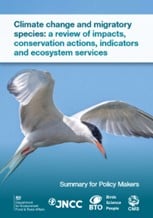
https://jncc.gov.uk/climate-migratory-species-report/
Climate change is already having catastrophic impacts on many migratory animals and their ability to provide vital ecosystem services to humanity according to a major new report of the Convention on the Conservation of Migratory Species of Wild Animals (CMS), a UN biodiversity treaty. Released on 10 December 2023 at the UN Climate Change Conference in Dubai (UNFCCC COP28), the report finds that the direct effects of climate change on many migratory species are already being seen, including poleward range shifts, changes in the timing of migration, and reduced breeding success and survival. Integral to the ecosystems they live in, migratory species support vital ecosystem services that both mitigate the impacts of climate change and increase the resilience to climatic hazards. The study also emphasizes the urgent need to act now to help vulnerable migratory species adapt to a changing climate. Actions such as the establishment of comprehensive and well-connected networks of protected areas and other effective area-based conservation measures are crucial to support species movement in response to climate change, whilst direct human interventions, such as the translocation of vulnerable populations of species, will be needed in some cases.
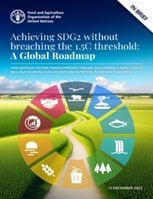
https://www.fao.org/interactive/sdg2-roadmap/en/
On 10 December 2023, the Food and Agriculture Organization (FAO) initiated the process for the development of a groundbreaking global roadmap aimed at eliminating hunger and all forms of malnutrition without exceeding the 1.5°C threshold set by the Paris Agreement. Unveiled at the United Nations Climate Conference COP28, the Global Roadmap for Achieving Sustainable Development Goal 2 (SDG2) without Breaching the 1.5°C Threshold outlines a comprehensive strategy spanning the next three years that encompasses a diverse portfolio of solutions across ten distinct domains of action. Against the backdrop of a projected 600 million people facing chronic hunger by 2030 and an escalating global climate crisis, the roadmap calls for a transformative shift in agrifood systems. It challenges the prevailing narrative that increasing production is synonymous with higher emissions and environmental degradation. Instead, it emphasizes the opportunity within agrifood systems to enhance production efficiency while aligning with climate mitigation, adaptation, and resilience objectives. The roadmap identifies 120 actions and key milestones within ten domains, supported by evidence gathered by FAO over several years. These domains include clean energy, crops, fisheries and aquaculture, food loss and waste, forests and wetlands, healthy diets, livestock, soil and water, and data and inclusive policies — the latter two identified as overall systemic enablers.
The guide to implementing the One Health Joint Plan of Action at national level
https://www.unep.org/resources/report/guide-implementing-one-health-joint-plan-action-national-level
The Quadripartite Collaboration on One Health releases this guide to support countries to strengthen their One Health actions. Recognizing the multitude of risks that a changing climate is having and will continue to have on the health of all life on earth, the launch took place at the United Nations Climate Change Conference (COP28) in Dubai, United Arab Emirates. The launch coincided with the first-ever health day at COP28 as well as a climate and health high-level ministerial meeting. The Guide is an operational addendum to the 2022 One Health Joint Plan of Action, signalling a strategic objective to country-focused implementation. The guide outlines three pathways – governance, sectoral integration, and evidence and knowledge – and five steps to achieve One Health implementation.

https://www.wto.org/english/res_e/publications_e/green_hydrogen_e.htm
A joint report by the International Renewable Energy Agency (IRENA) and the WTO published on 9 December 2023 provides insights into global hydrogen trade and policies for scaling up production. Hydrogen produced exclusively from renewable power — known as green hydrogen — is widely recognised as a key pillar in replacing fossil fuels and decarbonizing sectors that cannot easily be electrified, such as some industrial processes, shipping and aviation.
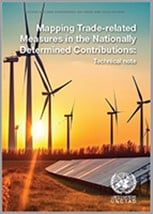
https://unctad.org/publication/mapping-trade-related-measures-nationally-determined-contributions
This UNCTAD study released at COP28 examines how 60 developing countries have integrated trade into their national pledges under the Paris Agreement, known as Nationally Determined Contributions (NDCs). The study, whose launch coincided with the summit’s inaugural “Trade Day” on 4 December, maps out how trade is systematically used in these national climate plans. The study identified 680 trade-related measures within the examined NDCs. In general, the study shows that most of them focus on increasing renewable energy, enhancing energy efficiency and promoting green value chains.
What’s Cooking? An assessment of potential impacts of selected novel alternatives to conventional animal products (UNEP)
https://www.unep.org/resources/whats-cooking-assessment-potential-impacts-selected-novel-alternatives-conventional

see also: What you need to know about new animal-source food alternatives (8 December 2023): https://www.unep.org/news-and-stories/story/what-you-need-know-about-new-animal-source-food-alternatives
Economic Growth and Sustainable Development

Report: https://iris.who.int/handle/10665/374504
Summary: https://iris.who.int/handle/10665/374814
Financial protection – affordable access to health care – is undermined when out-of-pocket payments for health care lead to financial hardship (impoverishing and catastrophic health spending) or create a barrier to access, resulting in unmet need for health care. This report summarizes the findings of a new study of financial protection in 40 countries in Europe, including the whole of the European Union, in 2019 or the latest available year before COVID-19. It finds that out-of-pocket payments lead to financial hardship and unmet need in every country in the study and are consistently most likely to affect households in the poorest fifth of the population. Financial hardship is largely driven by out-of-pocket payments for outpatient medicines, medical products and dental care – services that are commonly delivered or managed in primary care settings – indicating significant gaps in the coverage of primary care in many countries. The report identifies five coverage policy choices that countries should avoid because they undermine financial protection, equity, efficiency and resilience. It also identifies policy choices that have strengthened financial protection in countries with a low incidence of financial hardship and unmet need.
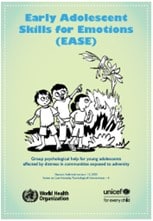
Early Adolescent Skills for Emotions (EASE) (UNICEF / WHO)
https://www.who.int/publications/i/item/9789240082755
Pathways to Achieving the Global 10-10-10 HIV Targets (UNDP)
https://www.undp.org/publications/pathways-achieving-global-10-10-10-hiv-targets
Public employment services and active labour market policies for transitions: Responses to mega trends and crises (ILO)
https://www.ilo.org/emppolicy/pubs/WCMS_888350/lang–en/index.htm
The first global report by the International Labour Organization (ILO) on public employment services explores their role in mitigating the labor market disruptions stemming from the COVID-19 crisis and potentially future crises. Additionally, it investigates the adaptive measures and innovative strategies these institutions have employed to navigate the evolving world of work during the past two decades.
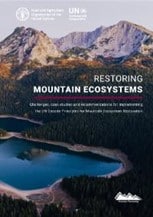
https://doi.org/10.4060/cc9044en
Mountains are home to a variety of ecosystems that provide vital services directly to 1.1 billion people and billions of others living in connected lowland areas. Half of humanity depends on mountains for the provision of freshwater alone. Mountain ecosystems cool local temperatures, increase water retention, provide carbon storage, and reduce the risk of erosion and landslides. Mountain forests, wetlands and grasslands also host and support half the world’s biodiversity hotspots. But the world’s mountain ecosystems are under attack due to their particular sensitivity to the planetary crises of climate change, biodiversity loss, food insecurity, and pollution and waste. Evidence shows that mountain ecosystems are affected at a faster rate than many other terrestrial habitats. This publication, jointly developed by the Mountain Partnership Secretariat at the Food and Agriculture Organization of the United Nations and the United Nations Environment Programme, analyses several mountain ecosystem restoration projects and recommends how the UN Decade’s Ten Principles for Ecosystem Restoration can be applied to mountain ecosystems. Mountain restoration success stories from initiatives that have been selected or shortlisted as the UN Decade’s World Restoration Flagships are also highlighted. As the theme of International Mountain Day 2023 is “Restoring Mountain Ecosystems”, this publication provides an important contribution in addition to celebrating the Five Years of Action for the Development of Mountain Regions 2023–2027.
World Economic Situation and Prospects 2024 (DESA)
Report & Executive Summary: https://desapublications.un.org/publications/world-economic-situation-and-prospects-2024
Global economic growth is projected to slow from an estimated 2.7 per cent in 2023 to 2.4 per cent in 2024, trending below the pre-pandemic growth rate of 3.0 per cent, according to the United Nations World Economic Situation and Prospects (WESP) 2024. This latest forecast comes on the heels of global economic performance exceeding expectations in 2023. However, last year’s stronger-than-expected GDP growth masked short-term risks and structural vulnerabilities. The UN’s flagship economic report presents a sombre economic outlook for the near term. Persistently high interest rates, further escalation of conflicts, sluggish international trade, and increasing climate disasters, pose significant challenges to global growth. The prospects of a prolonged period of tighter credit conditions and higher borrowing costs present strong headwinds for a world economy saddled with debt, while in need of more investments to resuscitate growth, fight climate change and accelerate progress towards the Sustainable Development Goals (SDGs).
Coronavirus Disease (COVID-19)

https://www.who.int/publications/i/item/9789240080959
Surveillance is a pillar of the public health response to epidemics and pandemics. Yet, gaps in surveillance, from the local to the global, continue to leave the world vulnerable to infectious hazards. To address these vulnerabilities, the health emergency preparedness, response, and resilience (HEPR) architecture calls for a new approach to future surveillance – collaborative surveillance – that aligns traditional tactics with new initiatives to safeguard health for all. This report reflects the input and advice on future surveillance of leading experts with different skills, worldviews and experiences who share a commitment to better prepare for future infectious hazards. It charts a course towards future surveillance and collaborative action.
International Peace and Security
Chair’s summary of the Arria-formula meeting of the Security Council on the theme: “Twenty-fifth anniversary of the Rome Statute: the contribution of the International Criminal Court to the maintenance of international peace and security”
English, French & Spanish: https://undocs.org/S/2023/942
This is the Chair’s summary of the Arria-formula meeting on the theme: “Twenty-fifth anniversary of the Rome Statute: the contribution of the International Criminal Court to the maintenance of international peace and security”, held on 18 July 2023 (see annex I). The concept note for the meeting is contained in annex II. Meeting attendees heard from several briefers, Security Council members and Member and observer States. A compilation of all statements made at the meeting, together with written statements received after the meeting, is contained in annex III.
Concept note for the Security Council open debate on the theme “Addressing the threat posed by diversion, illicit trafficking and misuse of small arms and light weapons and their ammunition to peace and security”
English, French & Spanish: https://undocs.org/S/2023/954
During its presidency of the Security Council in December 2023, Ecuador held an open debate on the theme “Addressing the threat posed by diversion, illicit trafficking and misuse of small arms and light weapons and their ammunition to peace and security”, on 15 December. This concept note was prepared to inform and guide the discussion.

https://eastandhornofafrica.iom.int/resources/my-life-my-plans-and-my-dreams-are-falling-apart-voices-sudan-conflict
The armed conflict in the Sudan that erupted in April 2023 has significantly impacted the lives of civilians, including foreign nationals such as Eritrean and Ethiopian migrants and refugees who were living in conflict-affected cities, such as Khartoum, when the violence broke out. Clashes have resulted in pronounced internal displacement and cross-border movements as civilians continue to flee. This report sheds light on the migration and displacement dynamics of these migrant groups who were in the Sudan before the conflict erupted and have been internally displaced by the recent crisis or fled the Sudan to Egypt. The report looks at why people are migrating, their experiences in Khartoum at the time of their flight, the gendered dynamics of migration, who is migrating and who is unable to do so, how they fled Khartoum, the challenges they faced during their migration as well as their experiences at destination. Findings are presented using respondents’ own words to amplify the voices of those displaced by the crisis. The report is the first in a series drawing from data collected as part of a larger research project looking at Ethiopian, Eritrean and Sudanese migrants on the Northern Corridor that runs from the Horn of Africa via the Sudan towards Northern Africa and onwards across the Mediterranean to Europe.

https://www.unescwa.org/publications/october-2023-gaza-deadliest-month-twenty-first-century-war
The ongoing war on the Gaza Strip is unfolding as the most severe episode of the 56-year Israeli occupation of Gaza, including the 16-year blockade, and other unlawful Israeli policies and practices. Although Gaza has suffered previous military escalations, the 2023 war stands out as unprecedented in the scale of death, destruction, and human suffering it has incurred, with repercussions that will echo for generations to come. The unprecedented impact of the current war on Gaza demands a transformative shift in addressing mounting immediate needs, reevaluating long-term systemic challenges to relief efforts, and confronting the root causes of the conflict by ending the occupation and upholding international law.

https://www.un.org/peacebuilding/content/impact-hub
On 8 December 2023, DPPA’s Peacebuilding Support Office (PBSO), in collaboration with the Permanent Missions of Canada, Costa Rica, Germany, and South Sudan to the United Nations, launched the Peacebuilding Impact Hub, a collaborative initiative to bring together the UN, governments, think tanks, academia, and civil society peacebuilders. The Peacebuilding Impact Hub will share knowledge from peacebuilders and partners; derive valuable insights and data-driven solutions; create space for learning; and demonstrate impact and cost savings of prevention.

https://www.unescwa.org/publications/war-gaza-weaponizing-access-water-energy-food-land
The present policy brief examines the devastating impact of the war on Gaza on the water, food and energy sectors across the Gaza Strip, the West Bank and southern Lebanon, highlighting the importance of safeguarding access to essential services in accordance with international humanitarian law and refraining from using them as tools of war. The ongoing conflict in Gaza has exacerbated an already dire humanitarian situation, compounded by 16 years of blockade and recurring military escalations. Since the outbreak of the war, essential services have been severely disrupted by deliberate attacks on civilian infrastructure, specifically agriculture, energy, water and sanitation systems, coupled with a ban by Israel on the entry of essential goods, including food, drinking water and fuel. This has resulted in a dire humanitarian crisis and widespread suffering. Gaza residents are forced to rely on unsafe water sources, face soaring food prices and shortages, and endure the effects of fuel and energy scarcity, impacting multiple industries and services. In parallel, the war’s consequences have triggered unprecedented levels of violence in the West Bank, resulting in displacement and the devastation of agricultural lands. Similarly, escalating tensions along the southern Lebanese border have resulted in the destruction of agricultural lands, natural areas, and water and energy infrastructure. To avoid further loss of life and human suffering, an extended humanitarian ceasefire in Gaza, with unimpeded and safe access to humanitarian aid and aid workers, is needed to ensure the provision of food, water, medicine and fuel. Subsequently, early recovery efforts should recognize the intricate relationship between water, energy and food, so as to contribute to simultaneous advancements in food security and nutrition, livelihoods, health, and water and energy access, thus paving the way for inclusive and sustainable development. Any meaningful development efforts must begin by ending the Israeli occupation and restoring the Palestinian people’s sovereignty over their natural resources, thus enabling them to invest in energy, water and agricultural infrastructure and regain control of the movement of people and goods.
Development of Africa

https://repository.uneca.org/handle/10855/49992
Climate-induced catastrophic events have led to severe humanitarian crises in Africa. Between 2000 and 2022, a total of 407.5 million people in Africa were affected by natural disasters. During this time, 4.2 million people became homeless, 53,610 people died and 52,205 were injured. This is according to the Economic Report on Africa 2023 (ERA2023) which was launched on December 18, 2023, in Abuja, Nigeria. The report shows that climate shocks generally are highly correlated with the cyclical component of GDP growth and not with the long-term trend in Africa, which suggests that part of the volatility observed in growth emanates from climate-induced shocks. A temperature increases beyond a threshold of 0.7 degree centigrade results in reduced real GDP growth. At 1.8-degree centigrade change in temperature, which is expected to prevail by 2030, if current trends persist, we could expect a 2-percentage point decline in real GDP growth, eroding the benefits from positive shocks, such as commodity price booms, and amplifying the impact of negative shocks. In addition, preliminary results of the report show that the frequency of natural disasters increases public debt levels directly. A unit increase in natural disasters could lead to a 0.25 percentage point increase in the ratio of net public debt to GDP.
Human Rights
https://www.ohchr.org/en/documents/brochures-and-leaflets/briefer-national-frameworks-safety-journalists
On various occasions, the High Commissioner for Human Rights underscored the need for governments to put in place frameworks for the safety of journalists. He also emphasised that to be effective, those frameworks should encompass prevention, protection and prosecution components, in line with the United Nations Plan of Action for the Safety of Journalists and the Issue of Impunity.
The present briefer was developed based on a study that the Office of the High Commissioner for Human Rights commissioned to the Geneva Graduate Institute, with a view to identifying good practices in the development of national frameworks for the safety of journalists. The briefer outlines the key principles that should guide the creation of such frameworks (a country specific approach, a strong political support, a human rights-based approach, a participatory approach, a gender-based approach, a strategic approach, a grounded approach, and a sustainable approach). It also details the prevention, protection and prosecution components of effective national protection frameworks.

https://www.undp.org/publications/collaboration-inclusion-and-solutions-good-practices-and-opportunities
Following the launch of the UNDP-UNHCR Global Collaboration Framework in December 2022, UNDP and UNHCR have been scaling up their work together to prevent and provide solutions to forced displacement. Collaborating for Inclusion and Solutions: Good Practice and Opportunities illustrates a sample of the diverse ways in which UNDP and UNHCR can work together and the benefits of this collaboration – from multi-country regional platforms to country-specific projects, data and analysis.

https://unama.unmissions.org/sites/default/files/the_handling_of_complaints_of_gbvawg_english_141223.pdf
The UN Assistance Mission in Afghanistan (UNAMA) has been monitoring the efforts of successive governments of Afghanistan to address incidents of gender-based violence against women and girls. Its newly released report on “The Handling of Complaints of Gender-based Violence against Women and Girls” notes that “the Afghanistan context after the Taliban takeover and the discriminatory restrictions imposed on women and girls further heightens their vulnerability to gender-based violence, both in the public and private sphere. The latter includes domestic and intimate partner violence given women and girls’ increasing relegation to their homes.”

https://www.globalprotectioncluster.org/index.php/publications/1672/policy-and-guidance/guidelines/guidance-integrated-approach-victim-assistance
What is an integrated approach to victim assistance? Realizing the rights, and addressing the needs of victims of cluster munitions, landmines, and other explosive remnants of war (ERW), requires a long-term commitment that should continue well after clearance work has been completed. The disarmament community has long understood that it is essential to realize victim assistance obligations through both specific initiatives, and broader development, human rights, and humanitarian efforts, in order to ensure sustainable support for victims.
https://www.ohchr.org/sites/default/files/documents/issues/youth/hr75/hr-75-youth-declaration.pdf
To ensure that youth engagement is at the core of the Human Rights 75 initiative, OHCHR created a Youth Advisory Group of 12 young human rights defenders from different regions, who were tasked to implement Human Rights 75 activities and promote the initiative among youth worldwide. In August 2023, together with the Youth Advisory Group, OHCHR conducted an online global youth consultation, where young people from all over the world shared their concerns and aspirations regarding human rights and discussed what should be done by youth, States, the United Nations, and the Civil Society Organizations to reinforce human rights in the future. In parallel with the consultation, an online survey and a call for input were launched to collect views of young people and youth-led and youth-focused organizations. The outcomes of the online global youth consultation, the survey, and the inputs received from youth organizations informed the development of the Human Rights 75 Youth Declaration, which was launched at the Human Rights 75 High-level event on 11-12 December 2023 in Geneva.
Human Rights Documentation – Digitization Update
https://www.un.org/en/library/digitization-update-–-international-conference-human-rights
In preparation for the commemoration of the 75th anniversary of the Universal Declaration of Human Rights (UDHR) on 10 December, the Dag Hammarskjöld Library has digitized the complete documentation of the International Conference on Human Rights held in Teheran, Iran, from 22 April to 13 May 1968. The conference documentation in all official UN languages, encompassing over 1,500 documents and about 22,000 pages, is now freely accessible in the UN Digital Library. These documents, with the series symbol A/CONF.32/–, include documentation of the preparatory committee, lists of participants, meeting records, and the Final Act of the International Conference on Human Rights that contains the Proclamation of Teheran (A/CONF.32/41). For more information, please consult our Research Guide on UN Document Symbols.
Implementing the Rights of Persons with Disabilities – the Role of Independent Monitoring Frameworks: Practical Guide (OHCHR)
https://www.ohchr.org/sites/default/files/documents/publications/professional-training/CRPD-Practical-Guide-web-compressed.pdf
Humanitarian Affairs
Checklist to ensure the meaningful engagement of young persons with disabilities in humanitarian action (November 2023) (UN Youth / UNFPA)
Report & Summary in English & Spanish: https://www.unfpa.org/resources/checklist-ensure-meaningful-engagement-young-persons-disabilities-humanitarian-action
https://www.preventionweb.net/publication/policy-brief-protection-persons-displaced-across-borders-context-disasters-and-adverse
This policy brief focuses on good practices that demonstrate how States can implement their commitments in an era of climate change. It was prepared jointly by the Platform on Disaster Displacement (PDD) and the United Nations High Commissioner for Refugees (UNHCR) for the Global Refugee Forum 2023. The Global Compact on Refugees recognizes disasters and the adverse effects of climate change as factors intertwined with drivers of refugee movements and calls for guidance and support to manage protection and humanitarian challenges of persons forcibly displaced in disaster contexts.
Justice and International Law
International Criminal Court (ICC), Office of the Prosecutor: Policy on Children
https://www.icc-cpi.int/sites/default/files/2023-12/2023-policy-children-en-web.pdf
Office of the Prosecutor of the International Criminal Court publishes new Policy on Children: Statement by ICC Prosecutor Karim A.A. Khan KC (8 December 2023): “As we witness the suffering of children globally, my Office has launched a new Policy on Children to help remedy their historic underrepresentation and lack of engagement in international criminal justice processes. This Policy represents a critical step to realising my consistent pledge to take a child-sensitive approach to investigations and prosecutions by articulating how we can proactively and explicitly consider their experiences in all our cases. Children have the right to participate in justice processes that involve them. It is the position of this Office that children’s voices will be heard in every case, every situation. Interaction with an individual child will of course depend on that child’s abilities, consent, and best interests. But at the case level, my Office will actively and affirmatively seek to engage with children so that we can better understand the ways they are targeted for and impacted by crimes under the Rome Statute. This Policy emphasises our view that all Rome Statute crimes may be committed against or affect children. Conflicts affect children in various ways depending on personal characteristics, including age, gender, disability, ethnicity, religion, where they live and their level of education. Countering a traditionally homogenous view of children, the Policy aims to actively reflect and adapt to issues related to intersectionality, children’s different developmental stages and their evolving capacities. …”
Safer shipping, cleaner seas – A celebration of 75 years of IMO
https://www.imo.org/en/MediaCentre/Pages/WhatsNew-2015.aspx
A book detailing the history of the International Maritime Organization (IMO) has been published to mark 75 years since the adoption of the IMO Convention, creating for the first time a global body to promote the safety and security of shipping and the protection of the marine environment.
Nuclear, Chemical and Conventional Weapons Disarmament
Celebrating 45 years of the Secretary-General’s Advisory Board on Disarmament Matters: Creative, inclusive, and cooperative diplomacy at work (UNODA Occasional Papers, No. 41, December 2023)
https://front.un-arm.org/wp-content/uploads/2023/12/OP41.pdf
This publication celebrates 45 years of cooperative diplomacy through the Advisory Board on Disarmament Matters (ABDM). In it, current and former members share their reflections on the Board’s past achievements, its evolution and strengths, and how to push for progress on life-saving disarmament topics during a trying time for international peace and security.
Newsletter Archive: https://unric.org/en/unric-info-point-library-newsletter-archive