
New UN websites & publications
TOPIC OF THE MONTH: Hate Speech

https://unesdoc.unesco.org/ark:/48223/pf0000397247
This handbook provides educators with a conceptual framework to understand the definitions, drivers and consequences of hate speech. It outlines concrete pedagogical practices, activities and resources to co-create inclusive learning spaces that promote diversity, cultivate critical thinking and facilitate the overall modelling of responsible citizenship that prevents hate speech and fosters a culture of peace. The handbook builds on the publication Addressing hate speech through education: policy guide, published by UNESCO and the United Nations Office on Genocide Prevention and the Responsibility to Protect (OSAPG) in 2023.

https://hdl.handle.net/10986/44314
Intergroup hate—both shaped by and shaping development processes—is spreading worldwide as hate speech becomes normalized, hate groups proliferate, and political discourse increasingly frames opponents as enemies rather than as partners in compromise. Drawing on historical, economic, political, and social-psychological research, this paper synthesizes 10 drivers of intergroup hate into four interlocking components: history, current context, call to arms, and justification of mistreatment. These components form a self-reinforcing cycle that escalates animosity and legitimizes harm, making hate difficult—but not impossible—to disrupt. The paper shows how the 10 drivers interact over time and uses the cycle of hate framework to organize evidence from experiments and program evaluations aimed at reducing intergroup animosity.

https://unesdoc.unesco.org/ark:/48223/pf0000392378
This guide explains what may count as hate speech, the harms it may cause, the way it works, and how media gatekeepers and other actors can address it. Many debates around hate speech are about law and regulation. Understanding the law, especially international law, can help journalists when reporting incidents where speakers are accused of hate speech. It can also help them analyse whether existing laws, as written and as applied, comply with international human rights approaches for striking the right balance between freedom of expression and the right to dignity, equality and non-discrimination.

https://www.un.org/sites/un2.un.org/files/comprehensive_methodology_monitoring_social_media.pdf
This report introduces a standardized methodology for monitoring online hate speech, to identify, assess, and mitigate risks, including when it constitutes risks of genocide, war crimes, and crimes against humanity. This methodology is based on an extensive review of existing methodologies used for this purpose across academia, technology companies, governments, the United Nations, and NGOs, and synthesizes those approaches into a standard set of practices that best fit the use cases relevant to the UN and its partners.
https://tinyurl.com/ymmn7mdx
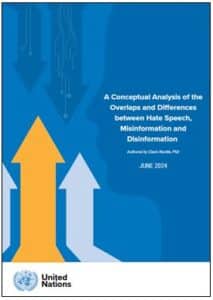
As part of events marking the 3rd International Day for Countering Hate Speech on 18 June 2024, this report was released examining hate speech, misinformation and disinformation, particularly in conflict-affected and high-risk areas. The report found that the tendency to group these distinct concepts together without taking into account their differences can make it difficult to address them more effectively. Commissioned by the United Nations Department of Peace Operations (DPO) and the Office of the Special Adviser on the Prevention of Genocide (OSAPG), and written by Dr. Claire Wardle from Brown University’s School of Public Health, the report aims to support both those working on the issues, as well as the general public to navigate hate speech, disinformation and misinformation in complex environments, by helping to clarify what these concepts mean, what they look like, and how best to respond.

https://www.ohchr.org/en/documents/tools-and-resources/hate-speech-and-incitement-hatred-electoral-context
The present information note seeks to provide users with guidance on a wide range of issues posed by hate speech and incitement to hatred in the context of elections. The note first seeks to provide guidance on differentiating between lawful speech, hate speech and incitement to hatred. It then examines issues of common targets of hate speech in the electoral context, mechanisms for addressing hate speech in the electoral context, the role of political leadership, the risks of regulating hate speech in the electoral context, and finally restrictions on the right to freedom of expression in the electoral context with regards to hate speech and incitement to hatred.

https://tinyurl.com/2t86zjn2
The UN Office on Genocide Prevention and the Responsibility to Protect launched on 5 July 2023 this policy paper on countering and addressing hate speech online. The policy paper was developed jointly by the UN Office with the Economic and Social Research Council (ESRC) Human Rights, Big Data and Technology Project at the University of Essex. The policy paper builds upon earlier initiatives, including The UN Strategy and Plan of Action on Hate Speech, which seeks to enhance the UN’s response to the global spread and impact of hate speech. The Strategy makes a firm commitment to step up coordinated action to tackle hate speech, both at global and national levels, including the use of new technologies and engaging with social media to address online hate speech and promote positive narratives.

https://unesdoc.unesco.org/ark:/48223/pf0000384872
Hate speech is spreading faster and further than ever before as a result of social media user growth and the rise of populism. Both online and offline, hate speech targets people and groups based on who they are. It has the potential to ignite and fuel violence, spawn violent extremist ideologies, including atrocity crimes and genocide. It discriminates and infringes on individual and collective human rights and undermines social cohesion. Education can play a central role in countering hateful narratives and the emergence of group-targeted violence. This policy guide developed by UNESCO and the United Nations’ Office on Genocide Prevention and the Responsibility to Protect explores these educational responses and provides guidance and recommendations to policy-makers on how to strengthen education systems to counter hate speech.

https://www.undp.org/publications/dfs-stepping-forward-parliaments-fight-against-hate-speech
This brief provides an overview of the background, drivers, enablers and the impact of hate speech and identifies strategies to counter it, with a focus on the role of parliaments as a positive force for change. Of particular relevance are the concrete actions parliaments can take to address and mitigate the prevalence and impact of hate speech on those who are most vulnerable in society, including women, minorities and other underrepresented groups. The objective of this brief is to provide meaningful and practical guidance for parliaments and parliamentarians, as well as those who programmatically support them, on steps they can take to reduce and counter hate speech while fostering peace, constructive dialogue and trust.
Further information:
- UN Digital Portal against Hate Speech – #NoToHate
https://www.un.org/en/hate-speech - United Nations Strategy and Plan of Action on Hate Speech
https://www.un.org/en/hate-speech/un-strategy-and-plan-of-action-on-hate-speech - Office on Genocide Prevention and the Responsibility to Protect – Hate Speech
https://www.un.org/en/genocide-prevention/hate-speech/strategy-plan-action - UNESCO: Countering hate speech – It starts with words
https://www.unesco.org/en/countering-hate-speech - UNRIC Library Backgrounder: Information Integrity – Selected Online Resources on Information Integrity, Misinformation, Disinformation and Hate Speech
https://unric.org/en/unric-library-backgrounder-information-integrity/ - International Day for Countering Hate Speech, 18 June
https://www.un.org/en/observances/countering-hate-speech
UN in General
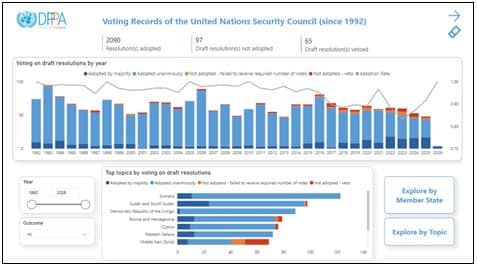
Voting Records of the United Nations Security Council (since 1992) Dashboard
https://main.un.org/securitycouncil/en/content/voting-records-1992
The Security Council Affairs Division has launched a Voting Records Dashboard, an interactive platform that provides public access to Council draft resolutions, agenda topics and voting records dating back to 1992. The dashboard allows users to explore how Council members have voted across thematic and country-specific issues over time, supporting research, analysis and institutional memory. The initiative strengthens transparency and understanding of Council practice and contributes to DPPA’s broader mandate to support informed engagement with the Council’s work.
English: https://unctad.org/publication/least-developed-countries-report-2025
French: https://unctad.org/fr/publication/rapport-2025-sur-les-pays-les-moins-avances-les-services-nouvelle-voie-vers-la
Spanish: https://unctad.org/es/publication/informe-sobre-los-paises-menos-adelantados-2025-los-servicios-una-nueva-hacia-la
The Least Developed Countries Report 2025, released by UN Trade and Development (UNCTAD) on 10 February 2026, finds that services are expanding rapidly across least developed countries. However, growth is concentrated in low-productivity activities that sustain livelihoods but do not generate prosperity at scale. Despite the growing role of services, average per capita growth in least developed countries remained weak in 2024. Employment is still dominated by informal retail, personal services and subsistence activities, while higher-productivity services that could support industrialization and competitiveness remain underdeveloped.

https://social.desa.un.org/publications/world-youth-report-2025
The 2025 World Youth Report on Youth Mental Health and Well-being examines how youth mental health and well-being are shaped by six social determinants, i.e. education, employment, family dynamics, poverty, technology, and societal attitudes. The Report highlights how inequalities in these areas create disparities in mental health outcomes, noting that stigma, discrimination, and unequal access to opportunities and care compound risks for young people. Drawing on extensive literature reviews, expert consultations, youth surveys, and real-life youth testimonies, the Report stresses cross-sectoral action, inclusive policies, and youth-led initiatives. Ultimately, it calls for comprehensive approaches that ensure no young person is left behind in achieving mental health and well-being.
Economic Growth and Sustainable Development
https://unu.edu/inra/news/new-unu-inra-report-critical-minerals
In this new report, UNU-INRA highlights that Africa holds nearly 30% of the world’s critical mineral reserves (cobalt, lithium, manganese, copper, nickel, graphite amongst others). It shows that global revenues from copper, nickel, cobalt, and lithium could reach $16 trillion by 2050, with Sub-Saharan Africa positioned for 10%+ of that value. This report launched at COP30 in Belém, shows that pivotal moment for Africa and the Global South to transform mineral wealth into sovereign power, industrialisation, and shared prosperity.

https://www.unescap.org/kp/2026/asia-and-pacific-sdg-progress-report-2026
At the current pace, the Asia-Pacific region is set to miss a staggering 103 out of 117 measurable Sustainable Development Goals targets by 2030. The Asia and the Pacific SDG Progress Report 2026, issued on 18 February 2026 by the United Nations Economic and Social Commission for Asia and the Pacific (ESCAP), also reveals a picture of deeply imbalanced development in the region. Gains in health and well-being, and poverty reduction these past decades, are being overshadowed by severe environmental decline and widening inequalities. Evidence shows setbacks in ensuring equal access to education (SDG target 4.5) and compliance with labour rights (SDG target 8.8). Furthermore, insufficient data on gender equality (SDG 5) and peace, justice and strong institutions (SDG16), is obscuring policymakers’ understanding of how effectively the most vulnerable are being reached. In critical areas such as climate action, marine conservation and biodiversity, the situation is not just stalling but rapidly deteriorating. For cities and communities, persistent regression, including damage to critical infrastructure, underscores a dangerous gap between planning and resilience on the ground.
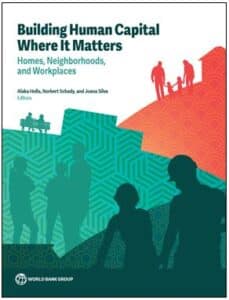
Report in English, Executive Summary in English, French, Spanish & Portuguese: https://hdl.handle.net/10986/44282
Associated content:
The Human Capital Index Plus 2026. Findings Brief: http://hdl.handle.net/10986/44305
The Human Capital Index Plus 2026: Methodology Note: http://hdl.handle.net/10986/44306
Human capital–the health, knowledge, skills, and experience that people accumulate throughout their lives–is essential for individual wellbeing and national development. No country has achieved sustained growth or reduced poverty without first investing in its people. But building human capital is not just about ‘what’ we do; it is also about ‘where’ we do it. This new flagship report complements the traditional sectoral or life-cycle approaches to human capital by focusing on the places where human capital is built: home, neighborhoods, and work. These spaces shape people’s opportunities to learn, grow up healthy, and earn a living–and are often overlooked in traditional policy approaches. By shifting attention to the places where human capital is built, the report broadens the menu of policy tools and unlocks new ways to improve lives and livelihoods. Supportive homes, stronger neighborhoods, and better work environments are an untapped source of better future jobs, productivity, and living standards. By unlocking this potential, people and economies will be better off. Taking action to build human capital where people grow, live, and work is both necessary and long overdue.
https://data.unfccc.int/
Global climate transparency entered a new phase with the launch of the Climate Data Hub, a centralized platform that – for the first time – consolidates climate data from more than 190 countries in one place, offering critical insight into progress, gaps, investment flows and support needs – insight essential to turning climate ambition into real-world outcomes in this new era of implementation. Developed by UN Climate Change in partnership with Microsoft, EY and NEDAMCO Africa, the Climate Data Hub provides reliable, official climate data that is easier to access, analyse and use, for all stakeholders – from government leaders and policy-makers, to investors and other real economy implementors, to academia and civil society groups.

https://unu.edu/sites/default/files/2026-02/ClimateTech-in-Focus-2025-AI-for-Sustainability.pdf
With contributions from more than 120 experts across 28 countries and regions, including 26 heads of state and ministerial-level officials, this report examines how artificial intelligence (AI) is increasingly embedded across energy systems, infrastructure, manufacturing, logistics, finance, certification, education and public governance. The report analyzes how AI is transforming climate mitigation and adaptation in practice, and what is required to translate technical capability into scalable sustainability outcomes. Rather than treating AI as a standalone technological breakthrough, the report emphasizes its role in reducing uncertainty, improving decision quality, and aligning complex systems under real-world constraints.

https://unhabitat.org/digital-metropolis-working-paper-projects-for-metropolitan-digital-transition
This Working Paper, jointly developed by UN-Habitat’s MetroHUB initiative and the Barcelona Supercomputing Center (BSC), guides metropolitan and local authorities, urban experts and practitioners, as well as technology solution developers, in shaping a metropolitan-scale digital transition. The document provides a practical framework to move from standalone initiatives to integrated projects that create public value, strengthen inter-municipal coordination, and build institutional capacity.
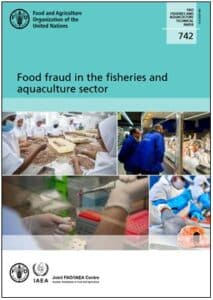
https://doi.org/10.4060/cd8244en
Fish fraud, in a variety of guises, is widespread in markets around the world, and there are a growing number of tools to combat it, according to this new report published by the Food and Agriculture Organization of the United Nations (FAO) on 10 February 2026. Produced by FAO through cooperation between its Fisheries and Aquaculture Division and the Joint FAO/IAEA Centre of Nuclear Techniques in Food and Agriculture, it offers an incisive portrait of the complex field of fraud and a review of how novel analytical techniques can help detect it.
Gen AI, occupational segregation and gender equality in the world of work (ILO Research Brief)
https://www.ilo.org/publications/gen-ai-occupational-segregation-and-gender-equality-world-work
Generative artificial intelligence (GenAI) is reshaping the world of work, with the potential to boost productivity, support job creation and improve job quality, but its impacts are far from gender-neutral. This new research brief from the International Labour Organization (ILO) warns that GenAI is set to affect women’s jobs more than men’s, with female-dominated occupations almost twice as likely to be exposed to the technology. The brief shows that women are disproportionately exposed to GenAI for three main reasons: they are overrepresented in jobs most susceptible to automation; they remain underrepresented in AI-related and science, technology, engineering and mathematics (STEM) occupations; and AI systems themselves often reflect and reproduce the gender biases embedded in societies.
Glacier Tourism in a Changing Climate: Balancing Conservation and Community Development (UNU-IAS)
https://unu.edu/sites/default/files/2025-12/UNU-IAS-PB-No53-2025.pdf
This policy brief explores the interconnected impacts of climate change and tourism on glaciers and their surrounding ecosystems and communities. It identifies practical approaches for more sustainable forms of glacier tourism, calling for coordinated policy action, stronger local engagement and integrated governance to ensure long-term resilience and equitable development in glacier-dependent regions.

https://doi.org/10.71245/FULK2623
This new report by the Intergovernmental Oceanographic Commission (IOC) of UNESCO reveals a critical lack of understanding of how the ocean absorbs and stores carbon. This glaring uncertainty about our planet’s largest carbon sink threatens to skew current climate predictions, and hamper our ability to develop effective mitigation and adaptation strategies in the coming decades. The report also lays out a roadmap to bolster international cooperation, strengthen ocean carbon monitoring and update climate models accordingly.

https://unece.org/trade/publications/unece-eclac-joint-study-making-trade-work-circularity-improving-circularity
Building on the 2024 UNECE-ECLAC report “Reversing direction in the used clothing crisis – Global, European and Chilean perspectives”, this study explores design options for trade-related technical regulations that promote sustainability in the global trade of used textiles while remaining consistent with World Trade Organization (WTO) rules and other international obligations. In WTO terminology, a technical regulation is a mandatory document that specifies product characteristics or related production methods with which compliance is required, typically established to protect public interests such as health, safety, or the environment. International trade can enable a circular economy for textiles by matching supply and demand for re-wearable clothing. Today, however, the system is distorted: ultra-fast fashion has driven volumes up and quality down; exporting countries struggle to separate rewearable items from waste; and importing countries face environmental, health and enforcement burdens. This study (ECE/TRADE/494) outlines a practical path to correct these distortions by designing technical regulations -grounded in WTO rules and aligned with international standards, that raise the quality of traded used clothing and reduce the flow of textile waste.

Re|shaping policies for creativity 2026: we share, we act, we build (UNESCO)
https://doi.org/10.58337/DQDA4649
UNESCO has launched the latest edition of its flagship report Re|Shaping Policies for Creativity, which analyses a rapidly evolving cultural landscape shaped by digital transformation, Artificial Intelligence (AI), shifting global trade dynamics, and mounting threats to artistic freedom. A global monitoring report with data from over 120 countries, it points out the need for stronger policies to protect creators from widening inequalities.

English: https://doi.org/10.54394/UJMT6226
French: https://doi.org/10.54394/MWNM1436
Spanish: https://doi.org/10.54394/00033111
The global gender pay gap remains high despite decades of commitments and can only be closed through coordinated action and deliberate policies, this new publication from the International Labour Organization (ILO) finds. The report proposes a new Theory of Change and Intervention Model based on coordinated actions and deliberate policies aimed at delivering real change in women’s pay and working lives. The findings show that laws and institutions, wage policies, pay transparency, objective job evaluation, social dialogue, labour inspection, social protection, care policies, and actions are essential to tackling gender stereotypes and reducing the gender pay gap.
https://www.who.int/publications/i/item/9789240120365
The World Health Organization (WHO) released on 11 February 2026 its first-ever consolidated operational handbook on sexually transmitted infections, to help countries urgently strengthen the prevention, diagnosis, treatment and care of sexually transmitted infections (STIs) across health systems. The handbook equips programme managers, policy-makers, clinicians, community organizations and partners with practical guidance that translates WHO’s recommendations on STIs into concrete operational approaches. It helps countries implement, integrate and sustain high-quality STI services within primary health care and universal health coverage frameworks.

https://www.unwomen.org/en/digital-library/publications/2026/02/women-in-the-diplomatic-corps-normative-frameworks-structural-barriers-and-policy-recommendations
This policy paper identifies promising practices for gender mainstreaming in foreign policy and provides recommendations to various actors in the ecosystem of diplomacy, including policymakers across government, especially within the foreign service of ministries of foreign affairs. It contributes to increased research on gender-responsive foreign policies with a focus on representation and participation of women in the diplomatic corps, the normative frameworks that influence their roles, and the structural barriers they confront on the path to parity. The paper was produced under UN Women’s global initiative on Gender-Responsive Foreign Policies, which is implemented in four regions (Arab States, Europe and Central Asia, Latin America and the Caribbean, West and Central Africa) with the support of the Ministry of Foreign Affairs of the United Arab Emirates through a Strategic Partnership Framework (2024–2027).

https://www.wipo.int/web-publications/world-intellectual-property-report-2026/en/index.html
New technologies are spreading across borders at unprecedented pace and gaps are narrowing in how intensively countries are using the innovations, the latest World Intellectual Property Report (WIPR) finds. The report draws on 250 years of historical data on technology use and five decades of patent scientific publication data to identify shifts that are reshaping global innovation dynamics and transforming economic opportunity. The report highlights the role of policymakers, who must focus on promoting invention as well as ensuring diffusion.
International Peace and Security
English & Spanish: https://www.undp.org/publications/global-progress-report-sustainable-development-goal-16
This Regional Snapshot provides a concise overview of progress toward Sustainable Development Goal 16 in Latin America and the Caribbean. Produced jointly by OHCHR, UNDP and UNODC, it distils the latest evidence on peace, justice and inclusion to complement the Global Progress Report on SDG 16. The publication highlights persistently high levels of violence in the region, including homicide, femicide, non-lethal violence and attacks on human rights defenders, while underscoring the importance of victimization and household surveys for capturing hidden forms of violence. It also reviews access to criminal and civil justice, pretrial detention, illicit financial and arms flows, bribery and the status of national human rights institutions. A section on inclusion examines birth registration, representation in public institutions, perceptions of political voice, satisfaction with public services and experiences of discrimination. Throughout, the Snapshot draws attention to significant data gaps, noting that the region has the second lowest SDG 16 data availability worldwide. Overall, the publication offers policymakers and practitioners a clear and accessible evidence base to support efforts toward more peaceful, just and inclusive societies.
Human Rights

45 Years of the Convention on the Elimination of All Forms of Discrimination against Women (CEDAW) – Standing Strong for Women and Girls: 45 Years of Law, Accountability, and Change (UN Human Rights Treaty Bodies)
https://www.ohchr.org/en/documents/tools-and-resources/45-years-convention-elimination-all-forms-discrimination-against

https://www.ohchr.org/en/publications/special-issue-publications/advancing-womens-rights-and-gender-equality-fifteenth
This commemorative volume documents and celebrates the achievements of the Working Group on discrimination against women and girls over the past fifteen years. It stands as a tribute to the tireless efforts of its members, showcasing the evolution of the mandate and its impact on addressing discrimination against women and girls globally. This publication not only commemorates the Working Group’s achievements within the larger framework of the work of the Office of the United Nations High Commissioner for Human Rights (OHCHR) on women’s rights and gender equality, but also serves as a testament to the enduring fight for gender equality.

https://www.ohchr.org/en/documents/reports/business-usual-human-rights-violations-and-abuses-against-migrants-asylum-seekers
This report, jointly published by UNSMIL and OHCHR, highlights patterns of human rights violations and abuses perpetrated with impunity against migrants, asylum seekers and refugees in Libya, as documented throughout 2024 and 2025. The findings reveal that widespread and systematic violations and abuses against migrants, asylum-seekers, and refugees persist, perpetrated by traffickers, smugglers, armed groups, and State-affiliated actors involved in migration and border management. The report sets out key recommendations to the Libyan authorities and the international community aimed at addressing these violations and abuses and ensuring effective protection.
Human rights situation in the Occupied Palestinian Territory, including East Jerusalem, and the obligation to ensure accountability and justice: Report of the United Nations High Commissioner for Human Rights (A/HRC/61/26)
https://www.ohchr.org/en/documents/country-reports/ahrc6126-human-rights-situation-occupied-palestinian-territory-including
This UN Human Rights Office report released on 19 February 2026 raises concerns over ethnic cleansing by Israeli authorities in both Gaza and the West Bank, amid increased attacks and forcible transfers that appear aimed at a permanent displacement of Palestinians throughout the occupied territories. During the reporting period, from 1 November 2024 to 31 October 2025 “intensified attacks, the methodical destruction of entire neighbourhoods and the denial of humanitarian assistance appeared to aim at a permanent demographic shift in Gaza”, says the report. “This, together with forcible transfers, which appear to aim at a permanent displacement, raise concerns over ethnic cleansing in Gaza and the West Bank.” In the Gaza strip, the report details the continued killing and maiming of unprecedented numbers of civilians over the course of the reporting period by Israeli forces, the spread of famine, and the destruction of the remaining civilian infrastructure — imposing on Palestinians conditions of life increasingly incompatible with their continued existence in Gaza as a group.

https://www.ilo.org/publications/social-health-protection-gender-equality
This new policy brief from the International Labour Organization (ILO) shows that social health protection is key to ensuring effective access to quality healthcare for women, and support their income security during sickness and maternity. The brief was published in time to mark International Women’s Day and it sets out practical guidance for the design of social health protection policies that work for women.
Sudan: Hallmarks of Genocide in El-Fasher; Report of the independent international fact-finding mission for the Sudan (A/HRC/61/77, Advance unedited version)
https://www.ohchr.org/en/documents/thematic-reports/ahrc6177-sudan-hallmarks-genocide-el-fasher-report-independent
The Independent International Fact-Finding Mission for the Sudan said in this new report on 19 February 2026 that the Rapid Support Forces (RSF) carried out a coordinated campaign of destruction against non-Arab communities in and around El-Fasher, the hallmarks of which point to genocide. While the Mission documented war crimes and crimes against humanity, the evidence establishes that at least three underlying acts of genocide were committed. These acts include killing members of a protected ethnic group; causing serious bodily and mental harm; and deliberately inflicting conditions of life calculated to bring about the group’s physical destruction in whole or in part — all core elements of the crime of genocide under international law. The report to the Human Rights Council found that genocidal intent is the only reasonable inference that can be drawn from the RSF’s systematic pattern of ethnically targeted killings, sexual violence, destruction, and public statements explicitly calling for the elimination of non-Arab communities, particularly the Zaghawa and Fur.
https://www.ohchr.org/en/documents/thematic-reports/wicked-problem-seeking-human-rights-based-solutions-trafficking-cyber
This report published on 20 February 2026 by the UN Human Rights Office graphically details the lived experiences of some of the hundreds of thousands of people trafficked from dozens of countries around the world into working in entrenched scam operations mostly in Southeast Asia, as well as far beyond. The report documents instances of torture and other ill-treatment, sexual abuse and exploitation, forced abortions, food deprivation, solitary confinement, among other grave human rights abuses. Survivors also shared experiences of border officials aiding scam recruiters, and of threats and extortion by police. Satellite imagery and on-ground reports show that nearly three-quarters of the scam operations are in the Mekong region, which have also spread to some Pacific Island countries and South Asia, as well as Gulf States, West Africa and the Americas.
Humanitarian Affairs
https://reliefweb.int/report/world/guidance-acting-ahead-epidemics-february-2026
OCHA Guidance: Acting Ahead of Drought
https://reliefweb.int/report/world/guideline-acting-ahead-drought-september-2025
Both designed for OCHA and partners at country, regional and headquarters-level, these guidances were developed in 2025 with the objective of giving an idea of suitable triggers and assistance packages for anticipatory action. They will be regularly updated with learning and good practices from implementation, in an effort to support continuous improvement of coordinated anticipatory action.

Routes Monitor (UNHCR)
https://data.unhcr.org/en/situations/route_based_approach
UNHCR, the UN Refugee Agency, has launched the Routes Monitor, a new data platform offering the most comprehensive picture to date of mixed movements across and along major global routes. Updated monthly, the platform brings together multiple sources of information – including from UNHCR, national authorities, UN and NGO partners, and media and social media monitoring – to show evolving trends, highlight protection needs and support more effective responses along entire journeys. This will help provide better protection and solutions where people are, offering alternatives to dangerous journeys. With a focus on protecting people at risk, the platform helps analyse today’s increasingly complex movements, where refugees fleeing conflict or persecution often move alongside people travelling for different reasons. Additional routes or route segments will be added progressively.

https://hdl.handle.net/10986/44369
Russia’s invasion of Ukraine continues to cause profound and far-reaching physical, socioeconomic, and environmental impacts, which will be felt for generations. This fifth Rapid Damage and Needs Assessment (RDNA5), undertaken jointly by the World Bank Group, the Government of Ukraine, the European Commission, and the United Nations, with support from additional partners, provides updated estimates of damage and losses as well as recovery and reconstruction needs. It presents an overview of nearly four years of impact, covering 46 months between February 2022 and December 2025 and building on the previous four assessments, RDNA1, RDNA2, RDNA3, and RDNA4.
Justice and International Law
Child Labour Observatory (ILO)
https://webapps.ilo.org/clodashboard/
The International Labour Organization (ILO) has launched the Child Labour Observatory (CLO), a new centralized platform bringing together country-level information on child labour across the ILO’s 187 Member States. Established following the Durban Call to Action on the Elimination of Child Labour, the CLO is designed as a one-stop shop for data, legislation, policies and evidence of progress to accelerate efforts towards the elimination of child labour.
https://www.undp.org/publications/countering-digital-scams-stemming-tide-urgent-development-challenge
This brief explores the significant development challenge posed by digital scams. It provides an overview of how digital scams threaten development, an assessment of key trends in digital scams with a particular focus on developing country contexts and lays out what is needed to develop effective and holistic responses to scams that can support and accelerate development. The brief aims to inform policymakers and international partners by framing digital scams as a development challenge, identifying policy and investment priorities, and highlighting the need for coordinated action across national, regional, and global levels. The paper draws on previous work led by UNDP’s Singapore Centre on scams, including the Anti-Scam Handbooks v. 1.0 and 2.0, UNDP’s experience in supporting digital programming in more than 130 countries, and UNDP’s global policy leadership on digital.

https://doi.org/10.4060/cd8473en
While progress has been achieved in land tenure and governance over the past 20 years, the ownership, tenure or use rights of only 35 percent of the world’s land is formally documented, according to the Status of Land Tenure and Governance, this new report released on 25 February 2026. Some 1.1 billion people, almost one in four of all adults, consider it likely they could lose the rights to some or all of their land and housing within the next five years, and this number has risen notably in the past few years, highlighted the report, produced by the Food and Agriculture Organization of the United Nations (FAO), the International Land Coalition (ILC) and the French agricultural research and cooperation organization, CIRAD.

Report in English, Executive Summary in English, French, Spanish & Portuguese: https://doi.org/10.1596/978-1-4648-2196-7
Women, Business and the Law 2026 is the 11th in a series of annual studies measuring the laws and policies that affect women’s economic opportunity in 190 economies. The 2026 edition presents an updated Women, Business and the Law 2.0, a new framework that assesses three pillars capturing both de jure and de facto dimensions of gender equality: legal frameworks, supportive frameworks, and enforcement perceptions. Women, Business and the Law 2026 updates its index of 10 topics structured around a working woman’s life cycle: Safety, Mobility, Work, Pay, Marriage, Parenthood, Childcare, Entrepreneurship, Assets, and Pension. This edition also includes important methodological updates, including a new partial-credit scoring approach and revisions to several questions across topics.
Nuclear, Chemical and Conventional Weapons Disarmament

https://unidir.org/publication/securing-cyberspace-for-peace-insights-into-cyberthreats-and-international-security-in-2025/
This UNIDIR report examines the key developments in the global cyber threat landscape in 2025, focusing on their implications for international peace and security. Informed by public reporting, expert insights and the outcomes of the UNIDIR Cyber Stability Conference 2024, the report provides a structured overview of evolving threats, changing threat actor dynamics and the disruptive influence of emerging technologies.
Drug Control, Crime Prevention and Counter-terrorism
https://unicri.org/Publication-Strengthening-Environmental-Crime-Journalism-Insights-Recommendations-Global-Training-Feb-2026
This briefing paper by UNICRI, the Nature Crime Alliance and the Financial Accountability and Corporate Transparency (FACT) Coalition sheds light on the key challenges facing investigative journalists reporting on environmental crime worldwide — and outlines practical recommendations to strengthen the field. The report draws on discussions and survey findings from a specialised training workshop held from 29 September to 1 October 2025. The workshop brought together more than 110 journalists and communications professionals from across the globe to deepen their understanding of environmental crime, investigative techniques and crime convergence dynamics.
Waste Crimes and Trafficking (UNODC)
https://tinyurl.com/bdfyev3k
Illegal waste flows are causing economic, public health and environmental damage, especially in low-income countries, while a patchwork of regulations enables criminals to evade punishment, according to a new analysis from the UN Office on Drugs and Crime (UNODC) released on 25 February 2026. In “Waste Crimes and Trafficking”, a new installment of the Global Analysis on Crimes that Affect the Environment, UNODC examines the five main illegal waste trafficking categories: electrical/electronic waste (e-waste), plastic waste, end-of-life-vehicles and engines, metal and metal bearing wastes, and waste mixtures, as well as the modus operandi of the organized crime groups and corporations involved. It finds that legislative gaps, limited enforcement capacities, lack of traceability and low penalties are all facilitating a trade that some estimate to be worth billions of dollars.
Newsletter Archive: https://unric.org/en/unric-info-point-library-newsletter-archive