
New UN websites & publications
TOPIC OF THE MONTH: 80th Session of the General Assembly
English: https://www.un.org/en/ga/
French: https://www.un.org/fr/ga/
Spanish: https://www.un.org/es/ga/
The 80th regular session of the General Assembly will opened on 9 September 2025, the General Debate will commence on 23 September 2025.

General Assembly High-level Week, 22 – 30 September 2025
English: https://www.un.org/en/high-level-week-2025
French: https://www.un.org/fr/high-level-week-2025
Spanish: https://www.un.org/es/high-level-week-2025
The 80th session of the United Nations General Assembly – under the theme Better together: 80 years and more for peace, development and human rights – comes at a pivotal moment to renew global commitment to multilateralism, solidarity and shared action for people and planet. This year’s high-level week highlights the urgency of delivering on the promise of the Sustainable Development Goals and reinvigorating global cooperation.
High-Level Meetings of the 80th Session of the General Assembly
English: https://www.un.org/en/ga/80/meetings/
French: https://www.un.org/fr/ga/80/meetings/
Spanish: https://www.un.org/es/ga/80/meetings/
Provisional Schedule
- Opening of the 80th session: 9 September 2025 | A/INF/80/1
- High-level Meeting to Commemorate the 80th Anniversary of the United Nations: 22 September 2025
- Sustainable Development Goals (SDG) Moment: 22 September 2025 | A/RES/74/4
- High-level Meeting on the 30th Anniversary of the Fourth World Conference on Women: 22 September 2025 | A/RES/79/288
- General debate: from 23 September to 27 September, and on 29 September 2025
- Biennial Summit for a Sustainable, Inclusive and Resilient Global Economy, on the theme “Implementing commitments on financing development”: 24 September 2025
- Climate Summit: 24 September 2025
- High-level Meeting on the Prevention and Control of Noncommunicable Diseases and the Promotion of Mental Health and Well-being: 25 September 2025 | A/RES/79/273
- High-level Meeting to Commemorate the 30th Anniversary of the World Programme of Action for Youth: 25 September 2025 | A/RES/79/289
- High-level meeting to commemorate and promote the International Day for the Total Elimination of Nuclear Weapons: 26 September 2025 | A/RES/79/47
- High-level Conference on the Situation of Rohingya Muslims and Other Minorities in Myanmar: 30 September 2025 | A/RES/79/278
Additional information
- Germany’s Annalena Baerbock elected President of the 80th General Assembly (2 June 2025): https://news.un.org/en/story/2025/06/1163936
- Frequently Asked Questions – General debate: https://gadebate.un.org/en/faq
- Delegates Handbook – Eightieth session of the United Nations General Assembly
https://documents.un.org/doc/undoc/gen/n25/214/16/pdf/n2521416.pdf - Highlights at the UN General Assembly: The 79th session – A Year in Review: http://eepurl.com/jlM43U
UN in General

English, French & Spanish: https://docs.un.org/A/80/1
“Introduction: The present report looks back on a year of headwinds and hope for humanity. In 2024, deadly conflicts continued to inflict massive suffering and displacement. Our planet shattered new heat records. Poverty, hunger and inequalities rose, while transformative technologies such as artificial intelligence expanded without effective guardrails, and international law and human rights were trampled. In the face of such challenges, the United Nations worked to translate our shared values into meaningful action on the ground for people around the world. … The present report demonstrates that despite enormously trying times – indeed, precisely because of them – we can and must keep pushing for the better world that we know is within reach. We will renew our efforts to achieve peace, foster sustainable development and defend and uphold human rights, for all of humanity.”
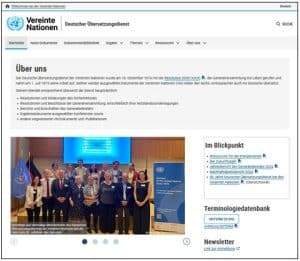
German Translation Section – new website
https://www.un.org/german/de
In 1975, pursuant to General Assembly resolution 3355 (XXIX) of 18 December 1974, the German Translation Section (Deutscher Übersetzungsdienst, DÜD) was established within the Department for General Assembly and Conference Management (DGACM). It is financed by the German-speaking member states (Germany, Switzerland, Austria and Liechtenstein).
The German Translation Section translates the resolutions and decisions of the Security Council, a selection of General Assembly resolutions, outcome documents of major UN meetings and conferences, the annual report of the Secretary-General on the work of the Organization as well as a number of other important UN documents and publications. (Source: Ask Dag – What UN documents are available in German? https://ask.un.org/faq/202226)

https://tinyurl.com/5rpwcwuy
To capture the outcomes of stakeholder participation at the 2025 UN Ocean Conference (UNOC3), the Division for Sustainable Development Goals (DSDG) in the United Nations Department of Economic and Social Affairs (UN DESA) has prepared the 2025 UN Ocean Conference Stakeholder Engagement Impact Report. The report provides an account of stakeholder engagement in the preparatory process and at the Conference itself, highlighting online consultations, the preparatory meeting, special accreditation, youth engagement, side events, and stakeholder interventions in official sessions. It also features participation figures, outreach activities, and key messages from stakeholders, demonstrating the breadth and depth of their contributions.
Economic Growth and Sustainable Development

https://hdl.handle.net/10986/43633
Many existing approaches to screen time management rely on simplistic time limits or general warnings that fail to address the complex realities families face. Parents often turn to screens as practical solutions to everyday challenges—needing to complete tasks, manage difficult behaviors, or simply find moments of relief. The “digital babysitter” phenomenon reflects legitimate needs, not merely poor parenting choices. This report moves beyond simplistic frameworks to offer a nuanced, evidence-based approach that acknowledges both the developmental concerns and practical realities of raising children in a digital world. Drawing from over 80 studies across 18 countries and six world regions, we present a comprehensive analysis of screen time impacts and intervention effectiveness.

Climate change and workplace heat stress: technical report and guidance (WMO / WHO)
https://www.who.int/publications/i/item/9789240099814
The World Health Organization (WHO) and the World Meteorological Organization (WMO) have published a new joint report and guidance on 22 August 2025 highlighting the growing global health challenges posed by extreme heat on workers. As climate change drives more frequent and intense heatwaves, many workers who are regularly exposed to dangerous heat conditions are already feeling the health impacts of rising temperatures, in particular, manual workers in sectors such as agriculture, construction and fisheries. Increasing heat episodes are also leading to health issues for vulnerable populations in developing countries, such as children, older adults and low-income populations.

https://www.itu.int/dms_pub/itu-s/opb/gen/s-gen-invest.con-2025-pdf-e.pdf
Achieving universal, meaningful Internet connectivity by 2030 could require an investment of USD 2.6 trillion to USD 2.8 trillion at current prices, according to the Connecting Humanity Action Blueprint released on 1 September 2025 by the International Telecommunication Union (ITU) – the UN agency for digital technologies – and the Communications, Space & Technology Commission (CST) of the Kingdom of Saudi Arabia. The report outlines the challenges, projected costs, and collaborative strategies needed to make sure everyone, everywhere, can use the Internet, including the estimated one-third of humanity currently offline.

https://www.who.int/publications/i/item/B09424
This new report from the World Health Organization (WHO) reveals that corporal punishment remains alarmingly widespread and causes significant harm to children’s health and development. Globally, an estimated 1.2 billion children aged 0–18 years are subjected to corporal (physical) punishment in their homes every year. Data across 58 countries show that 17% of children who experienced corporal punishment in the past month were subjected to its most severe forms – including being hit on the head, face, or ears, or being hit hard and repeatedly. The report highlights that children most at risk of experiencing corporal punishment are those with a disability; those whose parents experienced corporal punishment themselves; and those whose parents struggle with substance use, depression or other mental health conditions. Broader societal factors such as poverty, racism and discrimination further increase the risk of corporal punishment of children.
Handbook for Urban Heat Management in the Global South (World Bank)
https://hdl.handle.net/10986/43654

International Investment Agreements Navigator – IIA Facilitation Mapping
https://unctad.org/news/unctad-launches-new-database-investment-facilitation
UN Trade and Development (UNCTAD) is seeking to help countries better track and implement their international commitments on investment facilitation by launching a new database on 12 August. The database maps more than 400 international investment agreements (IIAs) since 2010, including the Investment Facilitation for Development Agreement finalized by participating members of the World Trade Organization (WTO) in November 2023. As investment treaties grow more complex, this new tool aims to promote transparency and support tailored technical assistance by UN Trade and Development. It also serves to inform policymaking ahead of major international conferences including the World Investment Forum 2026 and the WTO’s 14th Ministerial Conference where investment facilitation will be high on the agenda.

https://dtm.iom.int/reports/libya-climate-change-food-security-and-migration-report-june-2025
This report highlights the complex and growing challenges at the intersection of climate change, food insecurity, and migration in Libya. Climate-induced environmental degradation, including rising temperatures, desertification, and declining agricultural productivity, has emerged as a significant driver of food insecurity. Food insecurity in turn shapes migration dynamics, particularly among vulnerable rural populations whose livelihoods are closely tied to natural resources. The report also underscores how these pressures exacerbate existing social and economic vulnerabilities. By connecting climate, food systems, and mobility, the analysis provides valuable evidence to inform strategies for resilience and adaptation in Libya.

https://hdl.handle.net/10986/43420
Ports are crucial for global trade and particularly vital for low- and middle-income countries, handling over 11 billion tons of goods annually and supporting millions of jobs globally. However, ports increasingly face challenges in balancing efficiency, climate resilience, and sustainability. Nature-based solutions (NBS) can offer an additional tool for port authorities seeking to address these intersecting challenges effectively. In combination with traditional engineering, NBS offer a promising pathway to enhance climate resilience, promote environmental stewardship, and contribute to sustainability and development goals by integrating natural processes into infrastructure and operations. NBS can also play a significant role in maintaining ports’ social license to operate, strengthening relationships with coastal stakeholders, and creating opportunities for public-private partnerships. The guidance note outlines principles, opportunities, and examples to inform the adoption of NBS in the sector for port authorities, planners, policymakers, infrastructure professionals, and financiers. It is the result of a collaboration between the World Bank, the Global Facility for Disaster Reduction and Recovery (GFDRR), PROBLUE, and EcoShape, with funding from the Government of Japan.

https://www.who.int/publications/m/item/progress-on-household-drinking-water–sanitation-and-hygiene-2000-2024–special-focus-on-inequalities
Despite progress over the last decade, billions of people around the world still lack access to essential water, sanitation, and hygiene services, putting them at risk of disease and deeper social exclusion. This new report – launched by WHO and UNICEF during World Water Week 2025 – reveals that, while some progress has been made, major gaps persist. People living in low-income countries, fragile contexts, rural communities, children, and minority ethnic and indigenous groups face the greatest disparities.
https://tinyurl.com/ywdak252
Ninety percent of the world lives with either degraded land, unhealthy air, or water stress, according to this new World Bank report, however, restoring natural systems is possible and can yield high returns. In low-income countries alone, eight of out ten people live without all three – healthy air, water, and land – according to the report, released on 1 September 2025. This poses major constraints to economic growth and opportunity. New evidence shows that the loss of forests disrupts rainfall, dries soils, and worsens droughts, costing billions of dollars. The report also identifies a nitrogen paradox where fertilizers boost yields, but overuse in some regions harms crops and ecosystems, costing as much as $3.4 trillion annually. And air and water pollution silently damage health, productivity, and cognition, thereby sapping human potential.

Resilient Minds: The Unseen Struggles of Scientists in Wartime Ukraine (UNESCO)
https://unesdoc.unesco.org/ark:/48223/pf0000394849
The impact of war on scientists and the science ecosystem has been understudied, and as a result underestimated. This report seeks to change that, by drawing attention to the situation faced by Ukrainian scientists, university educational staff, scientific workers and young researchers.
The United Nations Economic Commission for Europe’s Urban Forest Compass: A planning and monitoring tool for cities and countries (ECE/TIM/2025/6, 31 July 2025)
English, French & Spanish: https://docs.un.org/ECE/TIM/2025/6
The document outlines the forthcoming United Nations Economic Commission for Europe’s Urban Forest Compass Dashboard. The work links to the United Nations Economic Commission for Europe’s on-going implementation of the San Marino Urban Forestry Action Plan, and its various initiatives on urban forestry.

https://tinyurl.com/ycxx9prw
International agricultural trade plays a central role in balancing global food supply and demand. Yet, with every shipment of crops crossing borders, the water used to produce them is virtually transferred as well, reshaping the distribution of water resources worldwide. This new report by the United Nations University Institute for Water, Environment and Health (UNU-INWEH) reveals that virtual water transfers through food trades generally reduce water scarcity for much of the global population, while at the same time deepening shortages for millions of others, particularly those in low-income communities.

https://www.who.int/publications/i/item/9789240114487
This atlas is a periodic survey and report of countries’ mental health policies and programmes, laws, information systems, financing, workforce and services. The 2024 edition, the seventh in a series that started in 2001, draws on data from 144 countries and includes several new indicators on service delivery including telehealth and physical health, community-based care, and data monitoring. This latest report provides an overview of global mental health systems and services, tracks progress towards the targets of WHO’s Comprehensive Mental Health Action Plan 2013–2030, and identifies key gaps in mental health service development across the world.

https://www.who.int/publications/i/item/9789240113817
Mental health needs are high, but responses are insufficient and inadequate. This report provides an update of mental health epidemiology, economic consequences and gaps in public mental health, drawing on the latest evidence. Over one billion people live with a mental disorder, yet most remain underserved. Mental disorders are a leading cause of disability; the economic consequences are staggering. Major gaps in resources, workforce, and quality of care leave most people without adequate support. This report provides essential data to guide national and global dialogue, including during the 2025 United Nations High-Level Meeting on Noncommunicable Diseases and Mental Health in New York.
see also: Over a billion people living with mental health conditions – services require urgent scale-up (WHO, 2 September 2025): https://www.who.int/news/item/02-09-2025-over-a-billion-people-living-with-mental-health-conditions-services-require-urgent-scale-up
International Peace and Security
Concept note for the Security Council open debate on conflict-related sexual violence, on the theme “Identifying innovative strategies to ensure access to life-saving services and protection to survivors of sexual violence in conflict zones”
English, French & Spanish: https://docs.un.org/S/2025/499
In its capacity as President of the Security Council for the month of August 2025, Panama convened an open debate on conflict-related sexual violence on the theme “Identifying innovative strategies to ensure access to life-saving services and protection to survivors of sexual violence in conflict zones”, in connection with the item entitled “Women and peace and security”, 19 August 2025. This concept note was prepared, outlining the thematic scope of the event.
Concept note for the Security Council open debate on the theme “The future of peace operations: key issues, opportunities and challenges in the context of the review on the future of all forms of United Nations peace operations”
English, French & Spanish: https://docs.un.org/S/2025/547
In its capacity as President of the Security Council for the month of September 2025, the Republic of Korea organized a Security Council open debate on the theme “The future of peace operations: key issues, opportunities and challenges in the context of the review on the future of all forms of United Nations peace operations”, on 9 September 2025. In order to guide the discussions on this topic, the Republic of Korea has prepared this concept note.
High-level International Conference for the Peaceful Settlement of the Question of Palestine and the Implementation of the Two-State Solution
https://www.un.org/unispal/high-level-conference-two-state-solution-july2025/
The High-level International Conference held from 28-30 July 2025 was a UN Member State-led conference, mandated through two resolutions of the General Assembly.
Report of the Special Representative of the Secretary-General for Children and Armed Conflict (A/80/266, 25 July 2025)
English, French & Spanish: https://docs.un.org/A/80/266
Grave violations against children have reached shocking levels in 2024, this new report of the Special Representative of the Secretary-General for Children and Armed Conflict to the General Assembly shows. The report, which covers the period from August 2024 to July 2025, highlights a staggering 25 % surge in grave violations compared to 2023. It stresses the dramatic impacts hostilities continue to have on children, pointing to the failure to respect international humanitarian and human rights law, disregard for the specific protection of children, and deepening humanitarian crises.
Report, Overview, Key messages, Fact sheet: https://www.un.org/en/peace-and-security/the-true-cost-of-peace
Global military spending is rising significantly across all regions driven by escalating geopolitical tensions, conflicts and perceived security threats. But does increasing military spending truly guarantee security? No, it often fuels arms races, deepens mistrust among countries and further destabilizes international relations. The Secretary-General’s report, as requested by UN Member States in the 2024 Pact for the Future, examines the difficult trade-offs presented by the increasing global military spending, making a powerful case for investing in peace and in people’s futures. It proposes a shift towards a human-centered and multidimensional approach to security, one that prioritizes diplomacy, cooperation, sustainable development and disarmament over military build ups.

https://unicri.org/Publications-Strategies-Partnerships-WPS-Agenda-Mauritania-Italy-Aug-2025
The United Nations Interregional Crime and Justice Research Institute (UNICRI) has released this new report, a strategic document that explores possible synergies between the two countries in the implementation of the Women, Peace and Security (WPS) Agenda. Prepared with the support of the Italian Ministry of Foreign Affairs and International Cooperation, this report offers an in-depth analysis of the institutional landscape in Mauritania, mapping the main actors – governmental, civil society, and international – involved in peace, security, and gender equality efforts. The report identifies concrete entry points for enhanced cooperation with Italy, based on consultations with local and regional partners. These exchanges provided valuable insights into ongoing initiatives, challenges, and opportunities for strengthening the implementation of the WPS Agenda.
Human Rights

https://www.unwomen.org/en/digital-library/publications/2025/08/gender-alert-four-years-of-taliban-rule-afghan-women-resist-as-restrictions-tighten
Four years since the Taliban takeover in August 2021, the women’s rights crisis is being normalized. Not a single decree restricting women and girls has been repealed; measures once framed as temporary are now entrenched as the norm. This gender alert counters such normalization by presenting 10 insights gathered through UN Women’s research and analysis undertaken since August 2021.
Humanitarian Affairs

https://www.unicef.org/documents/education-aid-cuts
This new UNICEF analysis shows that international aid to education is projected to fall by US$3.2 billion by 2026 – a 24 per cent drop. If the announced cuts to official development assistance (ODA) become a reality, UNICEF estimates that 6 million more children risk being out of school by end of 2026, 30 per cent of them in humanitarian settings. This is equivalent to emptying every primary school in Germany and Italy combined. It would raise the estimated number of out-of-school children from the current 272 million to 278 million. Among the countries facing the steepest setback, Côte d’Ivoire and Mali both risk of losing 4 per cent in current enrolment which translates to 340,000 and 180,000 students, respectively. Even children and young people who stay in school will be affected. With reduced support for system strengthening, such as curriculum development, learning assessment, and teacher development, at least 290 million students could experience a decline in the quality of their education almost overnight.
Justice and International Law

English: https://unesdoc.unesco.org/ark:/48223/pf0000395060
French: https://unesdoc.unesco.org/ark:/48223/pf0000395060_fre
Spanish: https://unesdoc.unesco.org/ark:/48223/pf0000395060_spa
On 18 August 2025, UNESCO and the International Association of Prosecutors (IAP) launched a new set of Guidelines for Prosecutors on Digital Evidence Collection in compliance with international standards on freedom of expression and privacy. Available in English, French and Spanish, these Guidelines provide practical tools for prosecutors to navigate digital evidence while protecting privacy and freedom of expression—two rights increasingly challenged in the digital era.
Nuclear, Chemical and Conventional Weapons Disarmament

https://unidir.org/publication/the-arms-trade-treaty-preventing-diversion-through-end-use-and-end-user-controls/
Poorly implemented controls on the end use or end user of exported arms can contribute to the diversion of those arms. This issue brief is intended to support States Parties to the Arms Trade Treaty (ATT) in effectively implementing controls on the end-use/r, using end-use/r documentation as a key tool to prevent arms diversion. This is in line with Article 11 of the treaty and in support of the implementation of other treaty provisions. The issue brief addresses existing discussions and good practices on end-use/r controls and how ATT States Parties use end-use/r controls, including documentation, within their own diversion-prevention measures. It also aims to improve understanding of underutilized potential and to identify options that could be pursued to strengthen control systems in order to more effectively implement the ATT’s provisions on diversion prevention and related efforts. This brief is intended to inform the ongoing exchange of national implementation practices within the ATT, specifically the discussion on national import controls, and future deliberations on intersecting issues.

New Directions for the Anti-Personnel Mine Ban Convention: Connecting Victim Assistance with the Women, Peace and Security Agenda (UNIDIR)
https://unidir.org/publication/new-directions-for-the-anti-personnel-mine-ban-convention-connecting-victim-assistance-with-the-women-peace-and-security-agenda/
A new opportunity emerged to strengthen synergies between mine action and the Women, Peace and Security (WPS) Agenda as States Parties to the Anti-Personnel Mine Ban Convention (APMBC) adopted the Siem Reap-Angkor Action Plan in November 2024. The plan explicitly recognizes, for the first time, the importance of synergies between mine action, notably victim assistance, and the WPS Agenda. This publication identifies potential actions that would align victim assistance with each of the four pillars of the WPS Agenda. It draws on a literature review and analysis of ongoing victim assistance programmes to show that greater synergy between these policy areas is not only possible but highly desirable, as it can reinforce the implementation of both the WPS Agenda and the APMBC.
Drug Control, Crime Prevention and Counter-terrorism

https://www.fatf-gafi.org/content/fatf-gafi/en/publications/Methodsandtrends/international-cooperation-against-money-laundering.html
The Financial Action Task Force (FATF), Egmont Group, INTERPOL and the United Nations Office on Drugs and Crime (UNODC), are calling for stronger global collaboration among analysts, investigators, prosecutors and others as they launch this practical handbook, providing essential tools to help countries speed up investigations and bring more criminals to justice. Money laundering almost always crosses borders, and criminals exploit gaps between national legal systems to hide their activities and avoid punishment. Yet FATF evaluations consistently show that investigating, prosecuting and sanctioning money laundering remains one of the weakest areas worldwide. Without more effective cooperation, countries cannot stop financial crime in its tracks. The handbook responds to the globalization of financial systems and rapid technological advancements, which demand faster intelligence and action to keep pace with criminals. It therefore promotes informal cooperation, such as secure communication channels, rapid response mechanisms and joint analysis, which can provide faster, more flexible, and targeted investigations, complementing formal, usually legal processes, which are often slower and procedurally complex.
Newsletter Archive: https://unric.org/en/unric-info-point-library-newsletter-archive