

660,000 children in the Gaza Strip are not going to school this autumn like most children in the world. Although UNRWA, the UN Palestine Refugee Agency, cannot provide education at the moment, it continues most of its operations in Gaza.
The Israeli forces have destroyed or damaged most schools and educational facilities in Gaza since the war flared up in October 2023 after the Hamas-led attacks on Israel. In addition, many UNRWA schools have had to be used to house homeless families.
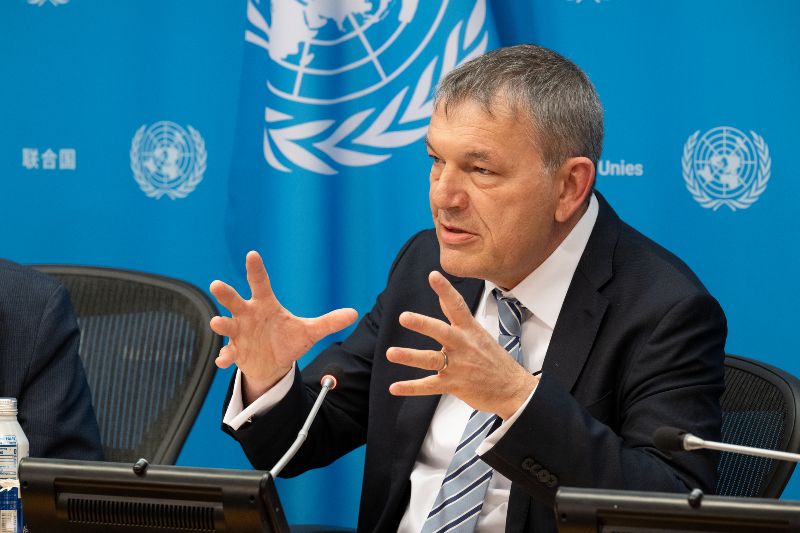
“Instead of going back to school…around 660,000 girls and boys in Gaza will be sifting through the rubble, desperate, hungry, traumatized and mostly bereaved,” Philippe Lazzarini the Commissioner General of UNRWA wrote on X, 1 September.

Another year out of school
This is the second autumn in a row that the children in Gaza do not go back to school. Since the beginning of the war, UNRWA was forced to shut all its schools in the Gaza Strip. It was able however to provide tens of thousands of children with some form of learning at temporary learning spaces and online.
UNRWA has been in charge of education of Palestine refugees since its foundation in 1949. Before the current war, UNRWA provided learning to half of them. The longer children are out of school, the more difficult it becomes for them to catch up on their lost education and the more likely they are to fall prey to exploitation. This includes child labour, early marriage, and recruitment by armed groups, according to UNRWA.
“This is a ticking bomb in Israel’s backyard. It is a win-win to have children back into school, including for Israel’s security and stability,” UNRWA states on its website.

Sowing seeds for more hatred and violence
“Gaza is in ruins – so is its education system,” Commissioner General Lazzarini pointed out on X. “The longer they stay out of school with their trauma, the higher the risk they become a lost generation, sowing the seeds for more hatred and violence.”
In addition to the armed conflict, UNRWA is facing important obstacles. In January 2025 Israeli legislation banning the UN agency for Palestine refugees, UNRWA, entered into force.

UNRWA: Still operating in Gaza
In spite of the legislation, UNRWA’s operations have not ceased in Gaza.
“Despite serious challenges UNRWA is still present and operates in the Gaza Strip,” Juliette Touma, UNRWA´s Director of Communications, told UNRIC.
“UNRWA has over 10,000 staff working in Gaza including over 1,500 working in health. Currently, UNRWA manages shelters with over 100,000 people living in them across the Gaza Strip. In 2025, we provided water, sanitation, hygiene services to approximately 1.3 million people.”
Although its role in education in Gaza has been severely impacted, the Palestine Agency continues its work for the benefit of Gaza´s children.
“Over half a million children have been reached with psychological support services since start of the war on 7 October 2023,” UNRWA´s Touma says.

Financial constraints
Sweden stopped supporting UNRWA in December 2024 due to the Israeli government’s ban on the agency’s operations, which made it difficult for Sweden to channel aid to Palestinians through UNRWA. The Israeli ban, in turn, was a response to allegations that some UNRWA employees participated in the October 7, 2023 Hamas attacks. Sweden stated its decision was to ensure aid could reach those in need through other humanitarian agencies.
“This is a sad day for Palestine Refugees and the multilateral system which Sweden has spearheaded,” Commissioner General Lazzarini said in a statement.
The remaining four Nordic countries, Denmark, Finland, Iceland and Norway have continued their funding after a temporary freeze following the allegations.

Investigations
An independent panel under the leadership of Catherine Colonna, the former Foreign Minister of France, was appointed and a separate internal investigation launched.
The “Colonna Report” confirmed in April 2024 UNRWA’s long standing commitment to uphold the humanitarian principle of neutrality.
Evidence obtained by the independent UN Office of Internal Oversight Services (OIOS), in a separate investigation, might indicate that nine staff members may have been involved. Their employment was terminated in the interest of UNRWA.
“However, since information used by Israeli officials to support the allegations have remained in Israeli custody, OIOS was not able to independently authenticate most of the information provided to it,” UN Deputy-Spokesperson Farhan Haq said.
UNRWA: background
UNRWA, the United Nations Relief and Works Agency for Palestine Refugees, is a UN agency established in 1949 to provide humanitarian assistance and protection to registered Palestine refugees and their descendants. Operating in Jordan, Lebanon, Syria, the West Bank, and Gaza, it provides essential services like education, health care, relief, and social services, funded almost entirely by voluntary contributions from UN member states.
See claims versus facts on UNRWA here and the latest UNRWA Situation Report here.
Help send humanitarian aid to Gaza, donate here