

“There can be no better rule of thumb for a Secretary-General, as he approaches each new challenge or crisis, than to ask himself, ‘How would Hammarskjöld have handled this?’”
Former UN Secretary-General Kofi Annan posed that question in Uppsala in September 2001, four decades after Dag Hammarskjöld’s death. It was a reflection of the lasting influence of the second UN Secretary-General and of the role he helped define for the United Nations in responding to international crises.
Sixty-five years ago this September, Hammarskjöld was killed while trying to broker peace in the Congo. On the night of 17–18 September 1961, the aircraft carrying the UN Secretary-General to Ndola, then in Northern Rhodesia, crashed shortly after midnight.
Hammarskjöld was travelling to meet Moïse Tshombe, the leader of the secessionist Katanga province, as part of efforts to negotiate an end to the conflict. Hammarskjöld, 56, and 15 others on board were killed.
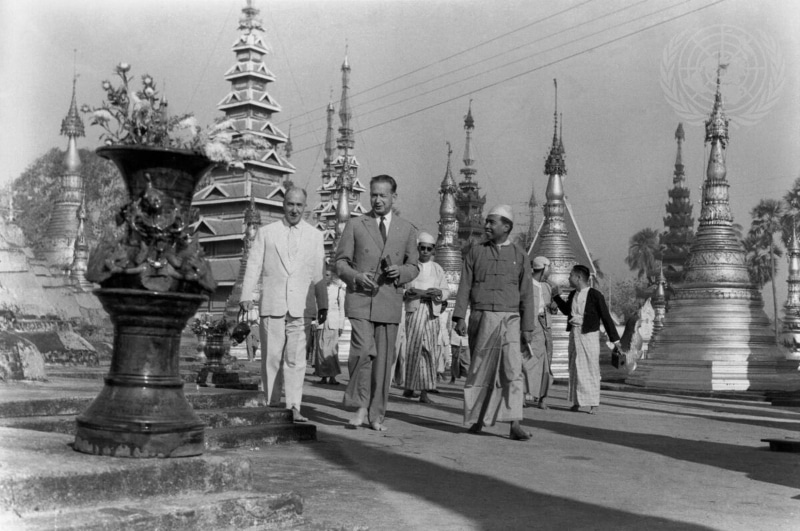
The youngest Secretary-General
Hammarskjöld’s death brought an abrupt end to a career that had seen him serve as Secretary-General for more than eight years. Appointed as the youngest person to serve as United Nations Secretary-General, taking office at the age of 47, unanimously in 1953 and re-elected for a second term in 1957, he led the Organization through some of the major international crises of the Cold War, including the Suez crisis and the Congo crisis. During his tenure, the role of the Secretary-General in international diplomacy and conflict management also developed significantly.
The shock of his death was felt far beyond the United Nations. Addressing the UN General Assembly in New York on 25 September 1961, US President John F. Kennedy paid tribute to the Secretary-General, declaring: “Dag Hammarskjold is dead. But the United Nations lives.”
Kennedy described Hammarskjöld as “a noble servant of peace” and urged the international community to ensure that his work had not been in vain. “So let us here resolve that Dag Hammarskjold did not live, or die, in vain,” he told the Assembly.
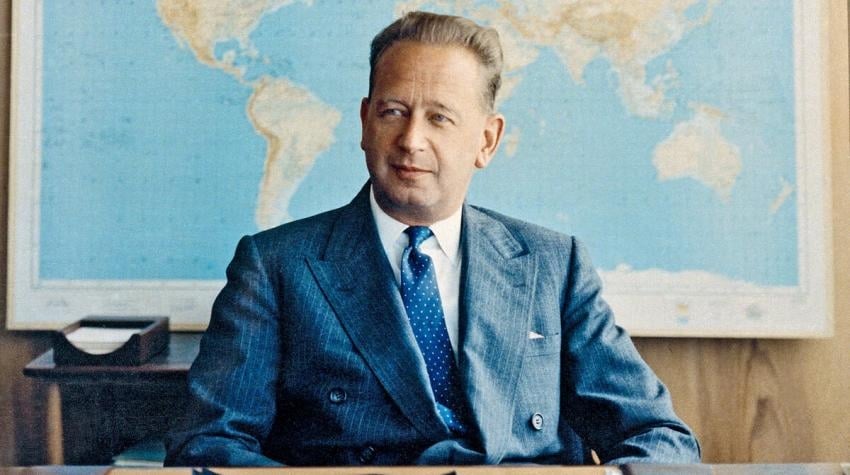
Circumstances still unresolved
The circumstances of the crash have remained the subject of investigation and debate for more than six decades. The initial inquiries suggested pilot error, but a United Nations Commission of Investigation in 1962 concluded that it could neither confirm nor exclude the various hypotheses surrounding the crash, including sabotage.
The case has been revisited several times. In 2024, a UN-appointed Eminent Person, Mohamed Chande Othman, reported that an external attack or threat remained a plausible explanation. He also concluded that it was “almost certain” that specific and crucial information relevant to the case remained undisclosed in the archives of some Member States.
Politically independent
Dag Hammarskjöld was born on 29 July 1905 and raised in Uppsala, Sweden. Before joining the United Nations, he had a career in Swedish public administration and finance. At the age of 31, after serving for a year as secretary at the National Bank of Sweden, he was appointed Permanent Under-Secretary of the Ministry of Finance, where he played an important role in shaping Swedish financial policy.
Although he served under a Social Democratic government, Hammarskjöld did not belong to any political party and regarded himself as politically independent. In 1954, he became a member of the Swedish Academy.
Hammarskjöld was also awarded the Nobel Peace Prize posthumously, becoming the only Nobel Peace Prize laureate to receive the award after his death.
“The supreme sacrifice”
The anniversary has prompted successive UN Secretaries-General to reflect on Hammarskjöld’s contribution to the Organization. In 2018, António Guterres delivered the annual Dag Hammarskjöld Lecture in Uppsala. He described Hammarskjöld’s death as the “supreme sacrifice”.
In 2001, Kofi Annan had addressed Hammarskjöld’s influence on the office of Secretary-General in a lecture in Uppsala. Reflecting on the challenges facing those who would hold the position after him, Annan said: “There can be no better rule of thumb for a Secretary-General, as he approaches each new challenge or crisis, than to ask himself, ‘how would Hammarskjöld have handled this?’” UN source
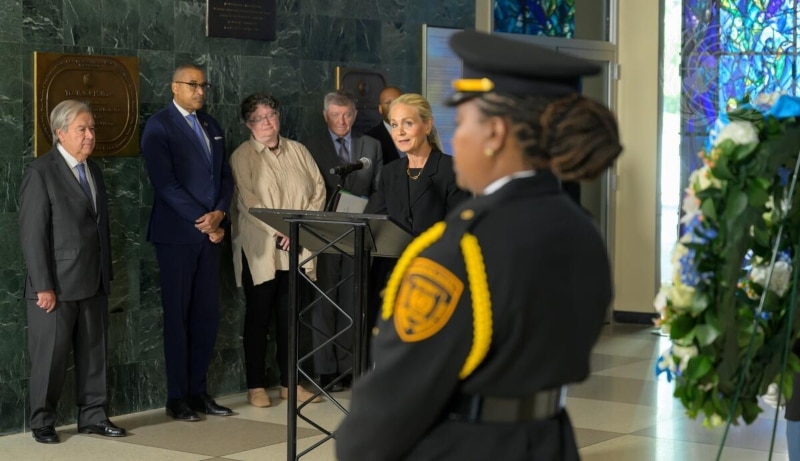
65th anniversary
On 8 September 2026, the United Nations held a wreath-laying ceremony at its Headquarters in New York to mark the 65th anniversary of Hammarskjöld’s death. In his remarks, Secretary-General António Guterres paid tribute to Hammarskjöld and to the 15 colleagues and crew members who died with him.
“We come together to pay tribute to the life and legacy of Dag Hammarskjöld, who was tragically killed 65 years ago,” Guterres said. “The values Mr. Hammarskjöld fought for – and the passion with which he pursued them — have made him a reference and inspiration for me and for countless UN colleagues through the years.”
Guterres also recalled those who accompanied Hammarskjöld on his final mission. “When we lay this wreath, we remember not only Mr. Hammarskjöld, but also the 15 colleagues and crew accompanying him,” he said. “They came from countries across the world and included political advisers, legal specialists, translators, security officers and pilots. None survived the crash.”
The 2026 commemoration took place against the backdrop of continuing questions about the circumstances of Hammarskjöld’s death. More than six decades after the crash, the United Nations continues to examine information concerning what happened near Ndola and to encourage Member States to provide relevant archival material. Guterres concluded by recalling Hammarskjöld’s own words on the relationship between personal responsibility and peace:
“Our work for peace must begin within the private world of each one of us. To build a world without fear, we must be without fear. To build a world of justice, we must be just.”