

With four years to go until the 2030 deadline, where do we stand with the Sustainable Development Goals (SDGs), adopted in 2015?
Countries had set out 17 Goals and 169 targets designed to tackle poverty and inequality, protect the planet and promote development that leaves no one behind.
The conclusion of the latest report on the SDGs, published on 7 July, is that only 36 per cent of the targets are on track or showing moderate progress, whilst nearly half (49 per cent) are progressing too slowly and 15 per cent have regressed.
The SDGs have helped to improve the lives of a large proportion of humanity: since 2015, nearly 1 billion more people have gained access to safe drinking water, and 1.2 billion to sanitation (sewage disposal and toilets).
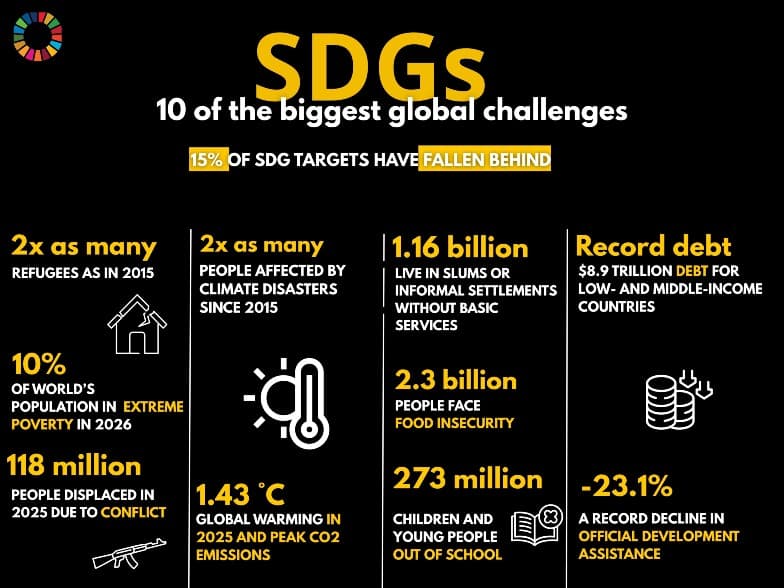
But obstacles remain and are sometimes exacerbated by conflicts, climate change and a record decline in official development assistance (-23.1 per cent in 2025 and -7.4 per cent in 2024).
“Without a decisive push to rapidly scale up proven solutions, the promise of the 2030 Agenda risks slipping out of reach,” warns the UN Department of Economic and Social Affairs.
There are still many reasons for hope…
Among the 10 most notable advances, internet access has soared from 40 per cent to 74 per cent of the world’s population between 2015 and 2025. This progress leads to further developments: better access to education and employment, and greater civic engagement among citizens.
Most regions are on track to eradicate extreme poverty by 2030, with the exception of sub-Saharan Africa, the Middle East and North Africa, and Oceania (excluding Australia and New Zealand).

Renewable energy capacity has doubled since 2015 and continues to grow.
In the health sector, the proportion of births attended by qualified health personnel rose from 80 per cent to 87 per cent between 2015 and 2025. It is on track to reach the target of 90 per cent by 2030.
… but the challenges are growing
One in ten people still live in extreme poverty.
Maternal mortality is nearly three times higher than the target set.
Despite changes to legislation in many countries, none of the gender equality targets are on track to be met.
The number of people affected by climate-related disasters has more than doubled since 2015.
The risk of extinction is mounting for all species. Only 45 per cent of the 16,600 key sites identified worldwide as essential for protecting biodiversity and ensuring the sustainability of life on Earth are protected (compared with 25 per cent in 2000).
Violent conflicts have reached their highest level in decades, wiping out years of development in a matter of months.
This escalation of violence, climate change, the slowdown in economic growth, the record rise in debt and the equally record fall in official development assistance are disproportionately affecting the most vulnerable populations.
What needs to be done now
“More than a decade of implementation has shown what is possible,” said Li Junhua, United Nations Under-Secretary-General for Economic and Social Affairs.
“The task now is to scale up what works — with the urgency, investment and cooperation needed to fulfil the promise of the 2030 Agenda.”
The greatest challenge today is to bridge the annual funding gap for the SDGs, estimated at around 4,000 billion dollars – the equivalent of the market capitalisation of some of the world’s largest companies.
Accelerating the energy transition, harnessing cutting-edge technologies for sustainable development, advancing gender equality and strengthening multilateral cooperation: these are the priorities set by the UN, which are crucial for future generations.
USEFUL LINKS
2026 Heroes of Tomorrow: UN SDG Action Awards
“Keeping The Promise” by 2030: The UN General Assembly’s SDG Moment