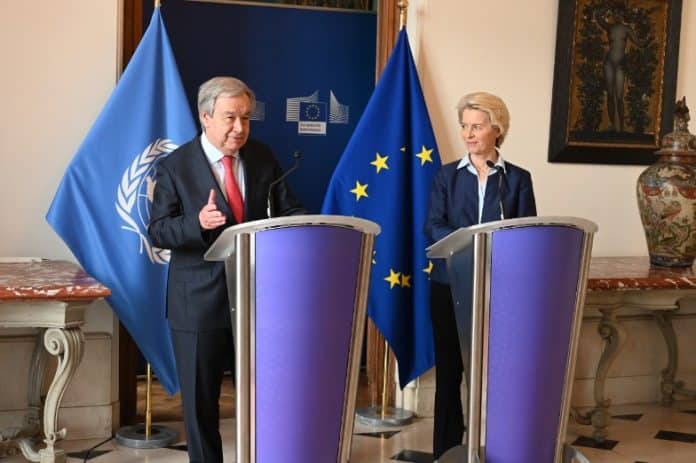
The United Nations (UN) and the European Union (EU) are working together at global, regional and country levels to promote humanitarian action, the Sustainable Development Goals (SDGs), human rights, and peace. The EU is committed to multilateralism with a strong UN at its core. In view of multiple crises and large-scale challenges affecting sustainable development, a solid alliance between the UN and the EU is more important than ever.
Who are we?
The UN Brussels Team (UNBT) is a global expert knowledge hub on EU-UN relations that brings together over 30 UN entities/offices. The team is led by the Director of the UN/UNDP1 Office in Brussels and Representative of the UN System in the EU, a position currently held by Ms. Camilla Brückner. The UNBT brings forward the UN’s impartial mandate, its extensive country presence, its trusted relationships with governments, its normative role and convening capacity. It represents an extensive expertise across the pillars of the UN – human rights, development and peacebuilding – and humanitarian.
How do we function?
The 30+ UN entities/offices1 coordinate their common work vis-à-vis the EU. Together, they present a unified voice to the EU and the Belgian Government. The team builds understanding and support for UN global norms and agendas both within the EU institutions and amongst a wider public in Europe. Additionally, the UNBT provides support to UNHQ (NY, Geneva and other locations), UN Resident Coordinators (RCs) and UN Country Teams (UNCTs), as well as other UN bodies, to facilitate a coherent engagement of the UN system with the EU. This includes policy engagement, advocacy, resource mobilisation, coordination around contractual issues through the Financial and Administrative Framework Agreement (FAFA) and, in some cases, programmatic engagement.
Who are our main counterparts?
Partners of the UNBT include the European Commission (EC), the European External Action Service (EEAS), the Council of the EU and the European Council, the European Parliament (EP) and various EU bodies; the Organisation of African, Caribbean and Pacific States (OACPS), the Belgian Government, Member States’ Permanent Representations to the EU and capitals, NATO, civil society organizations, non-governmental organizations, private sector, international and development financial institutions, think tanks, academia and several other stakeholders in Brussels.
Examples of engagements
With support from the UNBT, the UN and the EU engage regularly through:
- EC-UN high-level dialogues, bringing together the UN Secretary-General and the EC President along with their teams;
- the annual meeting between the Secretary-General and the European Council;
- regular visits by UN Principals, UN Resident Coordinators (RCs)2 and other high-level representatives meeting with EU senior officials;
- cooperation with the EU on UN intergovernmental fora and global summits, e.g. UN General Assembly; UN Economic and Social Council; High-Level Political Forum on Sustainable Development; and Conferences of the Parties.
- regular meetings at the strategic and technical level between the UNBT and the EU;
- participation in and organisation of public events in Brussels, e.g. with the European Parliament;
- support to country/regional dialogues and policy/programme cooperation between RCs/UNCTs and EU Delegations;
- regular engagement in the context of the Financial and Administrative Framework Agreement between the EU and the UN (FAFA).
UNBT Working Groups and Task Forces
The UN in Brussels coordinates its thematic engagement with the EU through working groups and task forces. They all work to advance key EU-UN priorities in the framework of the SDGs and the Pact for the Future by entertaining regular policy discussions with the EU3, for example through thematic dialogues and joint UN position papers. In total, there are nine interagency groups, each chaired by several UN entities.
Working Group on Digitalisation for the SDGs (ITU, UNESCO) fosters collaboration and enhances joint United Nations’ engagement towards EU institutions based in Brussels on digital policies and programmes.
Working Group on the FAFA is set up to align the UN and the EU on the contractual, administrative and financial aspects of the partnership.
Working Group on Gender Equality (UNFPA, UN Women) provides joint contributions to EU policies to women’s rights and gender equality, like the Gender Action Plan, and serves as a forum for coordination and information-sharing with the EU and among UNBT entities, with a view to integrating a gender dimension.
Working Group on a Resilient, Healthy and Food Secure Planet (co-chaired by FAO, UNEP, WHO) coordinates engagement with the EU and various other partners on a wide range of topics including environment, food security, nutrition, climate change, One Health, biodiversity and agrifood systems.
Working Group on Youth (UNEP, UNRIC) facilitates coordinated engagement with EU institutions and Member States on the youth agenda, including collaboration on EU policymaking processes, focusing on key areas such as education, green skills, meaningful youth engagement, and peace and security.
Task Force on the Global Gateway (GG) and Team Europe Initiatives (TEIs) (DCO, UNDP) maps UN’s engagement in GG initiatives and promotes collaboration between the UN and the EU’s flagship projects and TEIs, with a special focus on the country level.
Task Force on the Multiannual Financial Framework (MFF) (UNDP, UNICEF, and WFP) coordinates engagement with the EU on the upcoming MFF.
Task Force on the EU-UN Partnership in contexts of Crisis and Fragility (DCO, UNDP, and UNICEF) collaborates across all drivers of fragility and looks at ways to strengthen the EU-UN collaboration to promote increased coherence between the humanitarian, development and peacebuilding action to strengthen resilience to shocks.
Task Force on Migration (IOM and UN Director) coordinates the UN’s engagement with the EU on migration, forced displacement, protection and asylum. It facilitates multi‑stakeholder consultations and explores opportunities for joint programming and outreach in EU Member States and partner countries in the framework of the Global Compact for Migration, the EU Pact on Migration and Asylum, and the Pact for the Mediterranean.
Humanitarian Coordination Platform (OCHA) coordinates the collaboration with the EU on humanitarian affairs by promoting a shared understanding of the EU’s role in humanitarian crises, identifying opportunities to support the EU in humanitarian advocacy and response, and formulating UNwide messaging and engagement strategies. The platform also serves to coordinate UN involvement in key EU humanitarian processes and decision-making forums.
UN Communications Group (UNRIC) brings together UN communication specialists to share information, engage jointly with the EU and align on strategic UN communication priorities. All our communications work is underpinned by a focus on promoting information integrity.
Priorities
The UNBT, through its various working groups and task forces, will continue to engage with all EU institutions and the rotating Presidencies of the Council of the EU:
- To promote multilateralism, global solidarity and a rules-based international order, and to follow up on the implementation of the Pact for the Future.
- To further human rights, gender equality, youth engagement and the rule of law, and promote the overall approach of Leaving No One Behind of the 2030 Agenda.
- To contribute with normative and technical expertise to EU policy, legislation, and practice. This includes contributions to key EU multistakeholder fora organized in Brussels, including Senior Officials Meetings, the European Humanitarian Forum, Global Gateway related events, and more.
- To define and/or strengthen areas of shared EU-UN interest across a wide range of programmatic and policy issues (e.g. tackling fragility, food security, digital and agrifood transformation, and addressing the triple planetary crises).
- To support the EU-UN cooperation at country level, with special attention on leveraging the UN development system reform and the Resident Coordinators’ system to strengthen strategic collaboration for SDG acceleration.
- To facilitate strategic engagement of the wider UN system with EU institutions.
- To raise awareness with broader audiences of EU-UN cooperation and effective multilateralism.
1 These include: Controller’s Office, DCO, FAO, Global Compact, ILO, IFAD, IOM, ITC, ITU*, OCHA, OHCHR, OSRSG CAAC, UN-Habitat, UN Tourism*, UN Women, UNDP, UNECE*, UNEP, UNESCO, UNFPA, UNHCR, UNICEF, UNICRI, UNIDO, UNDRR, UNODC, UNOPS, UNRWA, UNRIC, UNITAR – CIFAL, UNU, WFP, WHO, World Bank Group. Entities with * are located outside of Belgium but are members of the UNBT. The offices of the UNBT members have different mandates, size, scope, and location. Some offices are Regional Offices for Europe (e.g. IOM) and also manage their organization’s dialogue with the EU. Some other offices are EU/Belgium/ACP liaison offices. Some offices run programmes implemented in Europe and beyond.
2 The Resident Coordinator is the senior-most representative of the UN development system on the ground, and reports to the UN SecretaryGeneral. RCs lead the UN country team (UNCT). The UNCT is the main UN inter-agency mechanism in-country for inter-agency coordination, coherence, and decision-making. It is composed of the representatives of UN entities undertaking development activities in the respective country, including those without permanent physical presence. There are 130 RCs, 132 UN Country Teams (UNCTs), covering 162 countries and territories worldwide.
3 Working groups are standing groups set up to address longer-term issues while task forces are designed to deal with specific assignments of either a technical or organisational nature with a fixed-term mandate.