
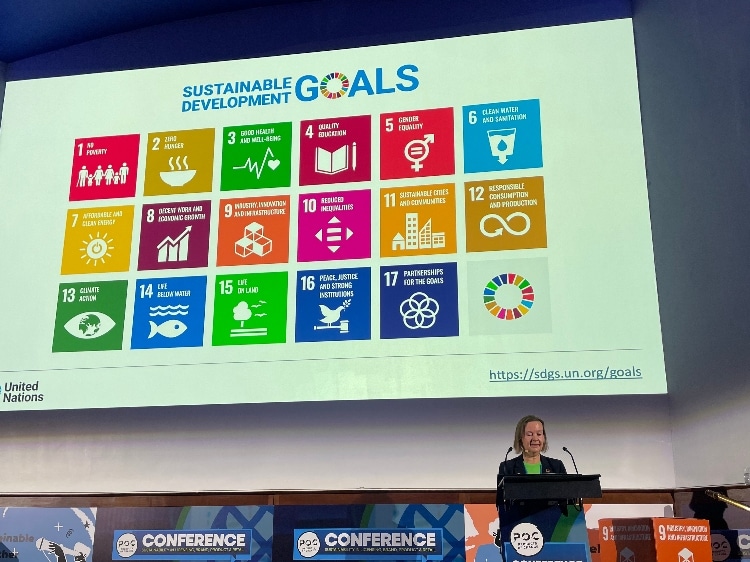
Over 400 innovators, entrepreneurs, and sustainability champions gathered at the Products of Change (POC) Conference to celebrate innovation and tangible action toward sustainability. Held at the Royal Geographical Society, the event brought together global leaders from across the retail, manufacturing, entertainment, fashion, and food industries to showcase progress on the UN Sustainable Development Goals (SDGs).
The conference underscored a core message: sustainability and profitability can go hand in hand. From a Nordic perspective, it highlighted a familiar ethos — that responsible design, circularity, and efficient use of resources form the foundation for long-term business success. Scandinavian companies such as IKEA and LEGO exemplified how innovation, purpose, and practicality can reshape industries for the better.

A Call for Creativity, Collaboration, and Courage
In her opening remarks, Caroline Petit, Deputy Director of the United Nations Regional Information Centre (UNRIC), praised the POC community for its vision and leadership in advancing sustainability within the brand and licensing sector.
She highlighted two important milestones this year — the 80th anniversary of the United Nations and a decade since the adoption of the SDGs — reminding participants that achieving the Goals requires a shift in mindset, bold leadership, and powerful partnerships.
“Create products with people and the planet, not just for them,” she added. “The greatest impact comes when consumers and communities are genuine partners in shaping them.”

LEGO and RDP: Redefining Responsible Production
Among the award winners, RDP Creative, in partnership with The LEGO Group, was recognized under SDG 12: Responsible Consumption and Production. Together, the companies have reimagined how products are made, packaged, and delivered — reducing waste while lowering costs across the supply chain.
“Optimizing packaging isn’t just about what’s around your product,” said Christian Lanckman, LEGO Packaging Manager. “It’s about how your business operates — fewer materials, less transport, lower EPR taxes, and a smaller carbon footprint. That’s good for the planet and for profitability.”
From eliminating single-use plastic to redesigning packaging for better freight efficiency, their work demonstrates that responsible production can also create economic value. In some cases, consumer prices have even decreased, challenging the perception that sustainability necessarily increases costs.

IKEA: Scaling Change through Leadership and Collaboration
IKEA showcased how sustainability can be embedded across large, complex operations. The company reported 23.7% growth between 2016 and 2024, alongside a 30% reduction in absolute carbon footprint.
IKEA’s approach is driven by top-down commitment — every retail manager also serves as a Chief Sustainability Officer (CSO) in their respective country, ensuring that environmental responsibility is embedded in all decision-making.
Partnerships and knowledge-sharing were also emphasized, particularly with SMEs that may lack dedicated sustainability teams but possess the drive to innovate. Supporting these smaller players, IKEA noted, amplifies impact beyond the company’s immediate value chain — a principle strongly aligned with the UN’s call for collective action across industries.
A Shared Message: Action Before Perfection
The conference highlighted that sustainability is built on both large initiatives and small, consistent actions. With one-third of global food production wasted annually and 26% of greenhouse gas emissions linked to the food system, even modest improvements in efficiency can have far-reaching effects.
“Don’t do business with those who don’t want to change,” said Wendy Mather, CEO of RDP Creative, reflecting the shared sense of urgency across the POC community.
An illustrative example of small-scale innovation comes from smol, a UK homecare company redefining sustainability in everyday products. As the first detergent brand to eliminate all single-use plastic, smol was founded on the belief that “something as small as a laundry capsule matters.” With the average UK household running a washing machine 208 times per year, smol demonstrates how incremental change can create measurable global impact.
Celebrating the Winners
The 2025 Products of Change Awards recognized companies excelling across the SDGs:
- SDG 17: Partnerships for the Goals – Eden Project, Dayrize, Pure Table Top, Fabacus
- SDG 12: Responsible Consumption and Production – RDP x LEGO Group
- SDG 13: Climate Action – Moose Toys
- SDG 9: Industry, Innovation, and Infrastructure – Universal Music Group & Bravado
Together, these organizations exemplify how innovation, responsibility, and collaboration can move in harmony, advancing both business objectives and global sustainability goals.
“Your achievements so far show that change is possible — and that it matters. But with five years to go until 2030, we must act with urgency and unity to transform lives everywhere. Together, let’s continue shaping a more sustainable, inclusive, and hopeful future,” Caroline Petit, UNRIC Deputy Director, concluded.


