

The first time Icelandic entrepreneur Ómar Antonsson visited the United States right after the 11 September 2001 terrorist attacks twenty-five years ago he was met with suspicion at the border. “On my passport they could see that my first name was Ómar and when they asked me what the purpose of my visit was, I told them truthfully that I was selling sand to Arizona,” Antonsson told UNRIC in an interview.
Ómar is not exclusively an Arabic first name and neither are the Arab states the only ones in the world that are blessed, or cursed depending on the point of view, with abundant quantities of sand.
Iceland is as a matter of fact just as rich in sand as in ice, and more sandy than some countries of the Arab region. Sand covers about 21-22% of the surface of the island which amounts to 22,000 square kilometers, while ice covers only 10-11%.

All sand is not suitable
However, the sand is quite different from the light brown sand of the Sahara or the red/orange/brown sand of North America. “The sand in deserts, including those in Arizona, is very fine, almost dust. It is not even good for use in concrete. It just good for filling your eyes and ears,” says Antonsson.
For this reason the hundreds of thousands of cubic kilometers of sand in the Sahara is of no use for the global construction industry and the raw material has to be sought elsewhere. And therefore, the amount of sand available worldwide is much smaller than one would think.

The black sand of Iceland is made of basalt and gabbro. The sand grains, which Mr. Antonsson exports, are 1-7 millimeters in size. This so-called “pearl sand” is popular for making swimming pools in North America, is widely used for pavements and driveways elsewhere, and adorns some gardens in Europe as a decorative feature.
The hero of development
Sand is extracted for various infrastructure needs that underpin modern society and development. “Sand is sometimes referred to as the unrecognized hero of development, but its essential role in sustaining the natural services on which we depend is even more overlooked,” said Pascal Peduzzi, Director of the UNEP Global Resource Information Database Geneva (UNEP/GRID-Geneva).

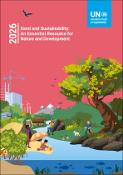
Surging global demand for sand, driven by population, economic, urbanization and infrastructure growth, is outpacing sustainable sand supply, threatening the ecosystems and livelihoods on which we depend, according to a new UN Environment Programme (UNEP) report, Sand and Sustainability: An Essential Resource for Nature and Development published in May 2026.
Construction consumes a large part of extracted sand but is also used in many other ways, including glass and microchip production.
50 bilion tonnes per year
It took nature hundreds of thousands of years to generate sand through gradual, geological erosion processes. Yet the world is using sand at the staggering rate of 50 billion tonnes per year. Its use for buildings alone is projected to rise by up to 45 per cent by 2060. “We are extracting it faster than it replenishes – this is the sand gap,” UNEP said in a press release to launch its recent sand report.

In 2024 China used fourteen billion tonnes of construction sand and gravel. Since 2000 the demand for sand in India has tripled.
The global market is estimated to be worth somewhere from at least $100 billion to almost $800 billion.
Marine sand watch
Of the 50 billion tonnes extracted, only 15 billion are legally mined according to reports. For this reason, international organisations have been forced to react. The European Union has set a goal for its member states to recycle 70% of construction and demolition waste.
UNEP launched Marine Sand Watch in 2023, a platform that analyzes the movements of dredging vessels in the world’s marine environments. The objective is to create a way for countries to check with the United Nations if ships are operating legally. So far, the new platform is on track to check as much as 60 percent of all dredging vessels worldwide.
Sand also provides critical habitats for fish, turtles, birds, crabs, and countless other species, supporting biodiversity and maintaining ecological balance – and is key to tourism and fisheries. About half of dredging companies are operating within Marine Protected Areas, accounting for 15% of the volume dredged.
“Sand is our first line of defence against sea level rise, storm surges, and salination of coastal aquifers – all hazards exacerbated by climate change,” UNEP said when it launched its recent report.
A cautionary tale
The 40,000 tonnes of sand that Ómar Antonsson mines annually in south-eastern Iceland are only a drop in the ocean, although one should not forget the carbon footprint of the transport across the Atlantic ocean and most of the American continent.

“I have no doubt that this industry is sustainable because the sand resplenishes itself. Just ask those who are making big efforts to maintain harbours on the sandy south coast of Iceland: they fill up with sand almost immediately,” says Antonsson.
However, the environmental damage that has been done to coastlines, not least in East Africa and India, is acautionary tale for the rest of the world.
Famous black sand
In recent years the black sand of Iceland has attracted more and more tourists largely thanks to the modern entertainment industry. While Iceland cannot yet boast of such classic desert movies as the Sahara (such as Omar Sharif in Lawrence of Arabia), its black southern desert has featured prominently in music videos of Justin Bieber, the Game of Thrones series and most recently in Christopher Logan´s movie, the Odyssey.

The worth of unspoiled nature is obviously harder to measure than exported sand, but at some point with the huge global demand for sand, it can´t be excluded that this might become a concern for Icelandic authorities.
Nature is unpredictable and only last year the most famous tourist attraction on the black sand coast of Iceland, Reynisfjara, lost most of its coastal sand overnight. This time it was not human activity that was to blame, but sudden changes in ocean currents and wind directions. This is a stark reminder of how fragile nature is and how long it takes nature, including sand, to renew itself. Nothing can be taken for granted.
See also in Icelandic and Danish