

Sweden will support UNESCO’s efforts to safeguard Ukraine’s Khortytsia National Reserve, through emergency conservation, documentation and capacity building.
Supported by Swedish Ministry of Culture, for the total amount of SEK 12 million (about USD 1.3 million), UNESCO-led emergency cultural heritage will intervene at the Khortytsia National Reserve in southeastern Ukraine, strengthening efforts to protect sites and collections affected in the context of the ongoing war following the invasion of Ukraine by the Russian Federation.
– Khortytsia, with its historical value, stands as a symbol of resilience and identity of the Ukrainian people. Protecting it today ensures that future generation will continue to learn from and be inspired by its legacy, says H.E. Mr. Vadym Omelchenko, Ambassador, Permanent Delegate of Ukraine to UNESCO.
Focus on preservation
The initiative focuses on the preservation of cultural property at Khortytsia, a key natural and historical site located along the Dnipro River in Zaporizhzhia oblast. The reserve has been under increasing pressure due to continued hostilities and the wider environmental consequences of the war, including the 2023 destruction of the Kakhovka Hydroelectric Power Plant, which exposed previously submerged archaeological remains and intensified risks to fragile heritage.
The sudden lowering of water levels in the reservoir system revealed archaeological deposits that had long been preserved underwater, while also destabilising the riverbank and increasing erosion of newly exposed layers of cultural remains.
Emergency actions include urgent repairs to the Khortytsia Reserve Museum, which suffered damage from repeated strikes in the region. Restoration works are expected to re-establish stable conservation conditions across approximately 3,000 square metres of museum space, supporting both storage and renewed public access.
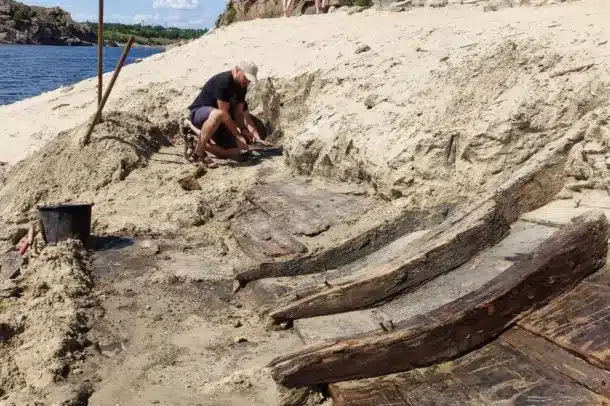
The project will also expand climate-controlled storage capacity for more than 5,000 rescued artifacts. This responds to the growing volume of archaeological material recovered from newly exposed riverbank sites, which remain at risk of erosion, looting and deterioration.
UNESCO-supported teams will scale up archaeological rescue missions and documentation, including the development of a standardized digital registry of affected sites to guide future conservation and stabilization. Environmental monitoring of Khortytsia Island will complement these efforts through assessments of biodiversity, water quality and soil stability.
– Sweden will remain unwavering in our support to Ukraine in its efforts to protect and preserve its cultural heritage and strengthen social cohesion, and its pursuit of a just and lasting peace, states H.E. Ms Helena Sångeland, Ambassador, Permanent Delegate of Sweden to UNESCO.
Capacity building
– A strong focus is placed on capacity building, with training and apprenticeships for young Ukrainian professionals in archaeology and conservation, developed in partnership with national universities. Cooperation with Sweden’s Vasa Museum will further strengthen expertise in underwater archaeology and the preservation of waterlogged cultural materials through joint training and knowledge exchange.
The involvement of the Vasa Museum brings valuable expertise to complement that of UNESCO. As a widely recognized and highly regarded institution, it also helps foster broader public engagement with this effort, says Ms Åsa Regnér, Deputy Director General of UNESCO.